
There was a time, not so long ago in the grand sweep of things, when the rhythmic clatter of a wooden loom was as common a sound in an English village as birdsong or church bells. Cottages across Lancashire, Yorkshire, the West Country, and the Welsh valleys hummed with the domestic textile economy, a world where whole families contributed to the making of cloth, from the youngest child carding wool to the father working the shuttle back and forth through the grey morning light. The handloom weaving history of England’s cottage industry is not simply an economic story. It is a story about how ordinary people lived, and how that life was taken apart, thread by thread.
How the Domestic Textile Economy Actually Worked
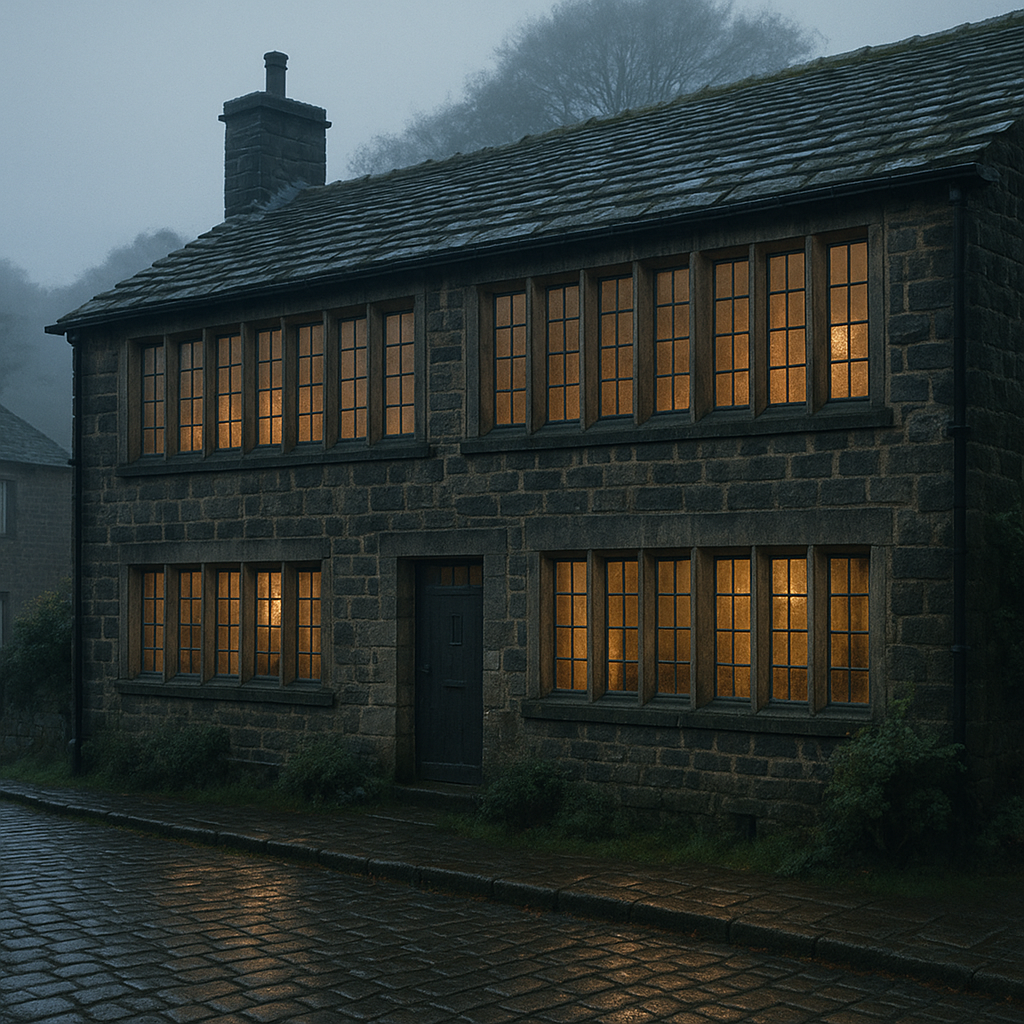
The putting-out system, as historians call it, was the engine behind centuries of English cloth production. A merchant, sometimes called a clothier, would supply raw wool or yarn to households, who would then spin, weave, and finish the cloth at home before returning it for payment. Entire communities organised themselves around this arrangement. In the West Riding of Yorkshire, villages like Sowerby Bridge and Heptonstall were dense with handloom weavers’ cottages, their upper storeys fitted with long horizontal windows specifically designed to flood the loom room with light. You can still spot these buildings today if you know what you’re looking for.
Wales had its own thriving textile tradition centred on the Teifi Valley in Ceredigion and the Tanat Valley in Powys, producing flannel and woollen goods that were traded at fairs across Britain. In the West Country, the Stroud valleys in Gloucestershire were famous for fine broadcloth prized across Europe. Every region had its specialism. This was not a cottage industry in the diminutive sense we sometimes use the phrase today. It was serious, skilled labour that fed families and built market towns.
The Spinning Jenny and the Beginning of the End
James Hargreaves is credited with inventing the spinning jenny around 1764, though the story of exactly how and where is a bit murky, which feels appropriate for a man whose invention caused such disruption. The jenny allowed a single spinner to work multiple spindles at once, dramatically increasing the amount of yarn that could be produced. For spinners, many of them women and children working in domestic settings, this was the first tremor before the earthquake.
Richard Arkwright’s water frame followed in 1769, and then Edmund Cartwright’s power loom in 1785. Each invention pushed production further away from the home and towards the mill. The handloom weaving history of England’s cottage industry cannot be separated from these inventions because they are, essentially, the story of its dismemberment. What had taken a family a week could now be achieved by a machine in hours. The clothier’s interest in the domestic weaver evaporated almost as fast as the profits shifted.
What Life Was Like for a Handloom Weaver’s Family
Before the mills fully took hold, a handloom weaver with steady work could earn a reasonable living. Early accounts from the 1790s describe weavers in the north of England eating meat regularly, keeping a small garden, and even owning a few books. There was a proud independence to the craft. A skilled weaver set his own pace, took breaks when he liked, and answered to no factory bell.
Children were part of the household economy from an early age. A child of five or six might wind bobbins or card wool. By their early teens, many were spinning independently. It sounds grim by modern standards, but within the framework of the time, this was family life functioning as it always had, everyone contributing, skills passed down the generations, the rhythm of work woven into daily existence.
The food on the table was simple. Oatmeal porridge, bread, potatoes, and on a good week a bit of bacon. The cottage itself was typically cramped, two or three rooms shared with the loom, which occupied a prime position near the window. In winter, the whole family might sleep near the loom for warmth. It was hard, but it was theirs.
The Human Cost of the Power Loom
By the 1820s, the handloom weavers were in serious trouble. The power loom had moved from curiosity to commercial reality, and the wages paid to domestic weavers had collapsed. A man who had earned 15 shillings a week in 1800 might struggle to get four shillings for the same week’s work by 1830. Families who had been modestly comfortable slid into poverty with alarming speed. Contemporary accounts describe weavers working eighteen-hour days just to maintain a subsistence income.
The Luddite movement, which began in Nottinghamshire in 1811 before spreading to Yorkshire and Lancashire, was partly a response to this crisis. Weavers and framework knitters smashed machinery not out of a hatred of progress, but out of desperation. The machine was eating their livelihood. The government responded by making machine-breaking a capital offence in 1812 and sending in the military. Seventeen men were hanged at York in January 1813. The history books often treat the Luddites as comic figures, technophobes raging against the inevitable. The reality was altogether more tragic.
The BBC’s history resources on the spinning jenny and early industrialisation give a useful account of how quickly and brutally this transition reshaped working lives across England.
What Survived and What Was Lost
The handloom weaving history of England’s cottage industry did not end entirely in the mill yards of Manchester and Bradford. Pockets of the old craft survived longer than you might expect. In the Harris Tweed tradition of the Scottish islands, domestic weaving on a treadle loom remains a legal requirement to this day, cloth must be woven at the home of the weaver to carry the protected Harris Tweed orb mark. In Wales, a small number of traditional woollen mills still operate in mid-Wales, many of them open to visitors, keeping methods alive that would have been recognisable to a Georgian weaver.
But the domestic textile economy as a mass phenomenon, as the backbone of rural and semi-rural household income across England and Wales, was gone by the 1850s. What was lost alongside the economic model was something harder to quantify: a particular relationship between labour and home, between skill and independence. The factory system was more efficient, certainly. It was also more anonymous, more disciplined, and far less forgiving of individual pace or rhythm.
The weavers’ cottages still standing in West Yorkshire, with their tell-tale rows of mullioned upper windows, are quiet monuments to a world that was reorganised out of existence. When you walk past one, it is worth pausing. Those windows were put there so someone could see what they were doing in the light of a grey northern morning, a shuttle in hand, keeping a family fed by a craft that had been handed down to them and would, in their generation, stop.