
Before the railways came, before the factory whistle blew, and long before anyone had heard of a hardware shop, virtually every English village had one indispensable figure at its centre. Not the vicar, not the squire, and not the miller, though all three were important enough. The person the whole parish quietly depended upon was the parish blacksmith. Stand near a forge on a cold morning and you understood it immediately: the heat, the clang of hammer on anvil, the shower of orange sparks. It was the heartbeat of rural England, and without it, the entire agricultural economy would have ground to a halt before breakfast.
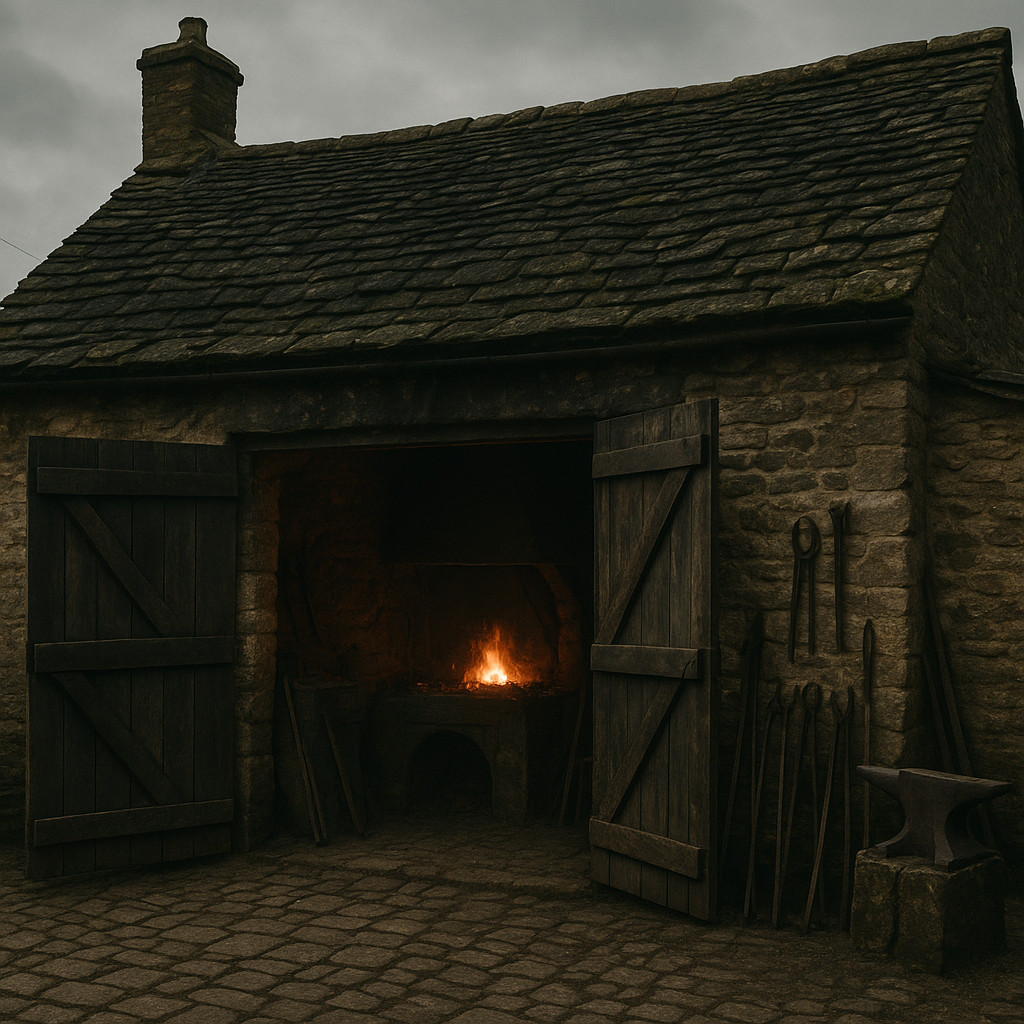
What Did the Parish Blacksmith Actually Do All Day?
The popular image is all horseshoes and brawny arms, and yes, farriery was part of the job. But to reduce a village blacksmith to someone who shod horses is a bit like saying the local GP just writes prescriptions. The blacksmith was, in every practical sense, the engineer of pre-industrial rural life. He forged and repaired the iron teeth of ploughs, made harrow tines, fashioned hoe blades, and kept scythes and sickles sharp and true. Harvest time, in particular, was frantic. The whole village’s food supply depended on those tools being ready before the wheat turned.
Agricultural implements were not cheap and were never simply thrown away. A broken ploughshare was brought to the smithy, hammered back into shape, and returned to service. The blacksmith was, by necessity, deeply familiar with the soil itself, because the weight and temper of a ploughshare had to match the clay-heavy land of the Midlands differently to the chalky downland of Wiltshire. This was applied knowledge, passed through generations of apprenticeship, not written in any book.
The Church, the Mill, and the Manor House
Step inside any old English parish church and look closely at the ironwork: the great strap hinges on the oak door, the decorative scrollwork on the chancel screen, the hasps on the vestry chest. Much of it came from the local forge. Medieval church ironwork was often highly decorative, and blacksmiths who could turn their hand to ornamental work were valued accordingly. The celebrated twelfth-century hinges on the south door of St George’s Church in Fordwich, Kent, are a fine example of the kind of craftsmanship that the parish blacksmith was expected to produce alongside purely functional work.
The mill was another constant source of work. Millstones needed iron bands to hold them together under the tremendous stress of grinding. Mill machinery required shafts, brackets, and gudgeons, all forged to precise specifications. The manor house had its own ironmongery needs too: fire grates, pot hooks, candleholders, gates, and railings. In a village economy with no equivalent of a builder’s merchant, everything iron came through one door.
The Smithy as Social Institution
Henry Wadsworth Longfellow wrote his famous poem about a village blacksmith in 1840, and whilst his version was rather romanticised and American in sensibility, the core observation held for England too. The smithy was warm when everywhere else was not. It was open early and late. Men gathered there while waiting for repairs, exchanged news, argued about the weather and the harvest, and generally treated it as an informal version of what the pub would later become. In some communities, the forge predated the alehouse by several centuries.
The blacksmith occupied a peculiar social position. He was a craftsman, which meant he ranked above a labourer, but he got his hands dirtier than almost anyone else in the village. He was not gentry, but he was not quite working class in the later industrial sense either. He was necessary in a way that gave him a kind of standing. You didn’t cross the man who made your plough and shod your horse. According to research held by the Historic England archive, many rural smithies in England date their continuous use back to the thirteenth and fourteenth centuries, making some of the oldest continuously operating craft sites in the country.
How a Blacksmith Learnt His Trade
Apprenticeships in ironworking typically began at around fourteen and lasted seven years. This was not unusual by pre-industrial standards, but the blacksmith’s trade demanded a particularly long learning curve because the work was so varied. Early years were spent at the bellows and doing light finishing work. By the third or fourth year, an apprentice might be trusted with basic farriery. The full repertoire, including tool tempering, ornamental work, and the finer points of agricultural ironmongery, took the whole seven years to acquire properly.
Tempering was perhaps the most skilled part of the job, and the hardest to teach. Different tools required different degrees of hardness. A chisel needed a different temper to a ploughshare, and a spring needed to be flexible rather than hard. Getting this wrong meant a tool that either snapped or bent out of shape too easily. The blacksmith read colour: the pale yellow of a correctly tempered chisel, the blue running along the surface of a draw knife at just the right moment. This was knowledge held in the eye and the hand, not on any page.
The Tools of the Trade
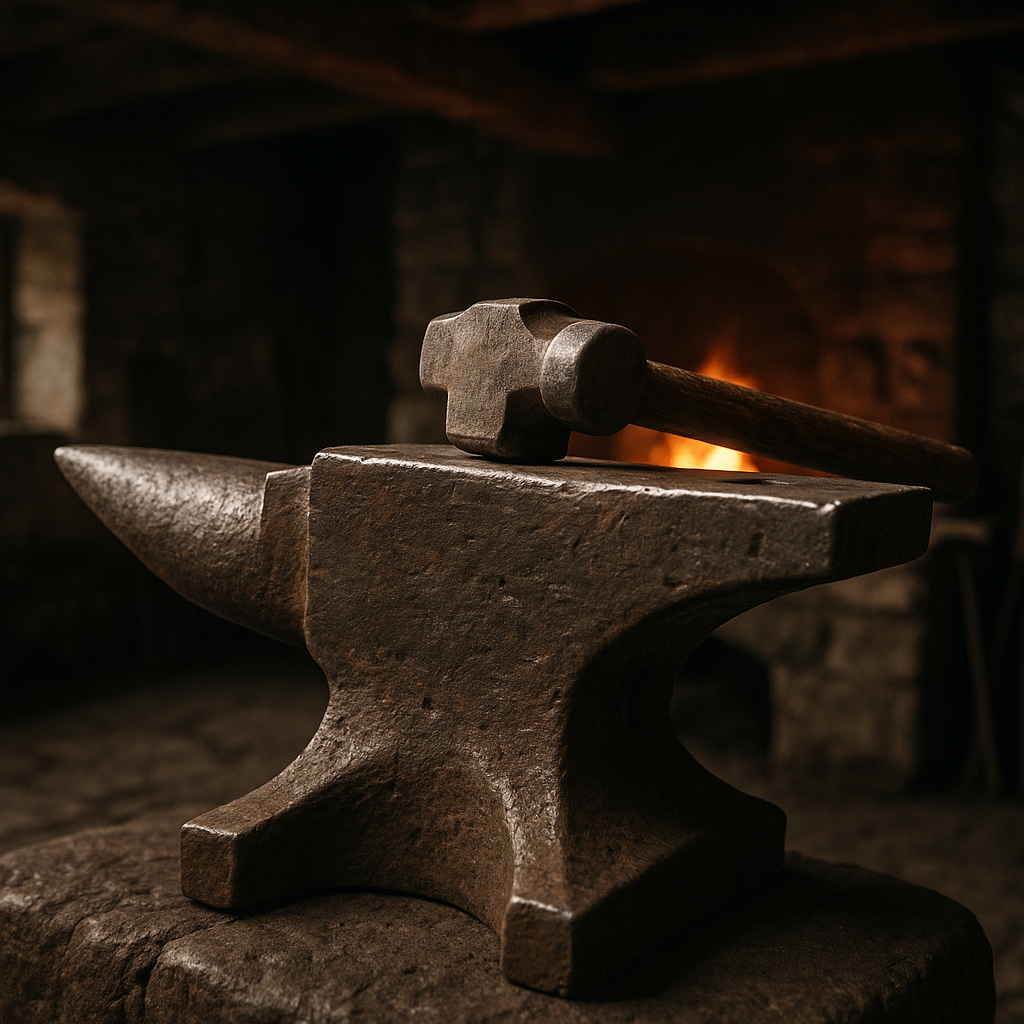
A well-equipped parish blacksmith’s workshop held a remarkable range of kit. The forge itself, usually coal-fired by the seventeenth century though charcoal had been standard before that, was the heart of everything. The anvil, often weighing well over 100 kilograms, was mounted on a heavy oak stump to absorb the impact of hammer blows. Tongs came in dozens of sizes for holding different shapes of hot metal. The hardy and the pritchel were set into the anvil’s square and round holes respectively, used for cutting and punching. Swage blocks, fullers, and sets allowed the smith to shape metal in ways that a flat anvil alone could not achieve.
A set of good tools was worth real money and was often passed down through generations. Inventory records from rural probate courts show blacksmiths’ tool sets appearing among the most valuable items in a craftsman’s estate, sometimes exceeding the value of the cottage itself. If you’re interested in researching your own village’s blacksmithing heritage, digging into old parish records can be genuinely rewarding, much like using free SEO tools to uncover what’s hiding beneath the surface of your local history.
The Parish Blacksmith’s Decline
The industrial revolution did not kill the rural blacksmith overnight. In fact, for a period during the early nineteenth century, increased agricultural activity meant the smithy was busier than ever. The arrival of mass-produced iron goods, cheap nails, and eventually factory-made agricultural machinery began to erode the craftsman’s role gradually. By the late Victorian era, many village smithies had pivoted heavily toward farriery, since the draught horse remained essential to farming well into the twentieth century.
The motor age and the tractor between them finally tipped the balance. By the 1950s, many traditional rural forges had closed. Some were converted to garages, which was at least a continuation of the engineering tradition in spirit if not in material. A small number survive today as working heritage demonstrations, including the restored forge at Acton Scott Historic Working Farm in Shropshire, which gives a vivid sense of what a busy parish smithy once looked and sounded like.
There is a quiet movement today to preserve what remains. The British Blacksmiths community and various rural craft organisations have worked to keep the skills alive, and a new generation of artist-blacksmiths has found an eager market for ornamental ironwork. The parish blacksmith as a full-service village engineer is long gone, but the craft itself refuses to disappear entirely. Perhaps that is fitting for a trade that once quite literally held rural England together, one hammer blow at a time.
Frequently Asked Questions
What was the main role of the parish blacksmith in an English village?
The parish blacksmith was essentially the village engineer, responsible for forging and repairing all iron tools and equipment. This included agricultural implements like ploughshares and scythes, church ironwork such as hinges and fittings, and household items like fire grates and pot hooks.
Did the village blacksmith only shoe horses?
No, farriery was just one part of a much wider role. Most parish blacksmiths spent the majority of their time on agricultural tools, building ironwork, and mill machinery. Shoeing horses was important but far from the whole job.
How long did it take to train as a blacksmith in pre-industrial England?
A traditional apprenticeship in blacksmithing lasted seven years, beginning around the age of fourteen. The trade required mastery of many different skills including tempering, ornamental work, and agricultural ironmongery, all of which took years to develop properly.
When did village blacksmiths start to disappear from English parishes?
The decline was gradual rather than sudden. Mass-produced iron goods in the nineteenth century reduced some of the work, but rural smithies remained busy into the early twentieth century. The widespread adoption of tractors and motor transport from the 1920s onwards significantly reduced demand, and many forges had closed by the 1950s.
Are there any working blacksmith forges you can visit in England today?
Yes, several heritage sites maintain working forges. Acton Scott Historic Working Farm in Shropshire is a well-known example, and various open-air museums across England including Beamish in County Durham and the Weald and Downland Living Museum in West Sussex also demonstrate traditional blacksmithing.