
There is something uniquely British about the outside toilet. Not glamorous, not comfortable, and certainly not warm on a February morning, the privy at the bottom of the yard was nevertheless a central fixture of working-class English life for centuries. Millions of families used one every single day, well into living memory. The outside toilet history of England, from the privy to the cesspit and everything in between, is the story of how ordinary people managed one of life’s most basic necessities with precious little infrastructure and absolutely no fuss.
It is easy to assume that indoor plumbing arrived and the problem was simply solved. The reality was far messier, far slower, and far more revealing about the class divisions that shaped this country.
Medieval England and the Cesspit: Out of Sight, Not Out of Mind
Long before back-yard privies became a fixture of the Victorian terraced house, medieval English towns and cities relied on cesspits. These were large pits dug beneath or beside a dwelling, into which household waste was deposited and left to accumulate. In wealthier establishments, a wooden or stone seat would be positioned above the pit, sometimes inside a small garden house or projecting from the upper floor of a building over a river. The River Thames in London received a frankly alarming quantity of the city’s waste for hundreds of years.
Cesspits were not emptied by magic. A trade grew up around the grim task: the gong farmer, or night-soil man. Working only after dark (hence the name), these men would descend into the pit, shovel the accumulated waste into barrels, and cart it away to be sold as agricultural fertiliser. It was dangerous, foul-smelling work, and the men who did it occupied the very bottom rung of the social ladder. Some towns paid them well, by the standards of the time, because nobody else would do it. The night-soil trade persisted in parts of England well into the nineteenth century.
The Tudor and Stuart Privy: A Step Towards Privacy
The word “privy” comes from the Old French for private, and by the Tudor period a distinct structure was emerging in English domestic life. A small outbuilding, often timber-framed, positioned at a discreet distance from the main house. Wealthier households might boast a proper “house of office” with plastered walls and a wooden bench fitted with a hole. The waste dropped into a pit below, or through a pipe leading to an external cesspit. At Hampton Court, Henry VIII famously had a “Great House of Easement” that could accommodate twenty-eight people at once, the Tudor equivalent of a corporate office restroom.
For ordinary people in towns and villages, the arrangement was considerably more basic. A shared pit, a rough wooden board, and four walls of wattle or timber were considered adequate. Privacy was a luxury, not a given. In densely packed towns, multiple families might share a single privy. The contents of the pit seeped into the surrounding soil, and frequently into the well from which those same families drew their drinking water. The consequences were catastrophic and, for centuries, poorly understood.
The Victorian Sanitation Crisis and the Earth Closet
By the mid-nineteenth century, England’s industrial towns were in a state of public health emergency. Cities like Manchester, Leeds, Birmingham, and Nottingham had swelled with workers drawn from the countryside, and the infrastructure simply could not cope. The 1842 Report on the Sanitary Condition of the Labouring Population of Great Britain, produced by Edwin Chadwick, laid out the crisis in brutal statistical terms. Average life expectancy for a labourer in Liverpool was seventeen years. Seventeen. The connection between contaminated water, overflowing cesspits, and disease was finally being taken seriously.
The Great Stink of 1858, when the Thames became so overwhelmingly polluted that Parliament itself was rendered nearly uninhabitable, finally jolted the authorities into action. Joseph Bazalgette’s London sewer network, one of the great engineering achievements of the Victorian era, began to take shape. But sewers reached cities unevenly, and the countryside and smaller towns lagged far behind.
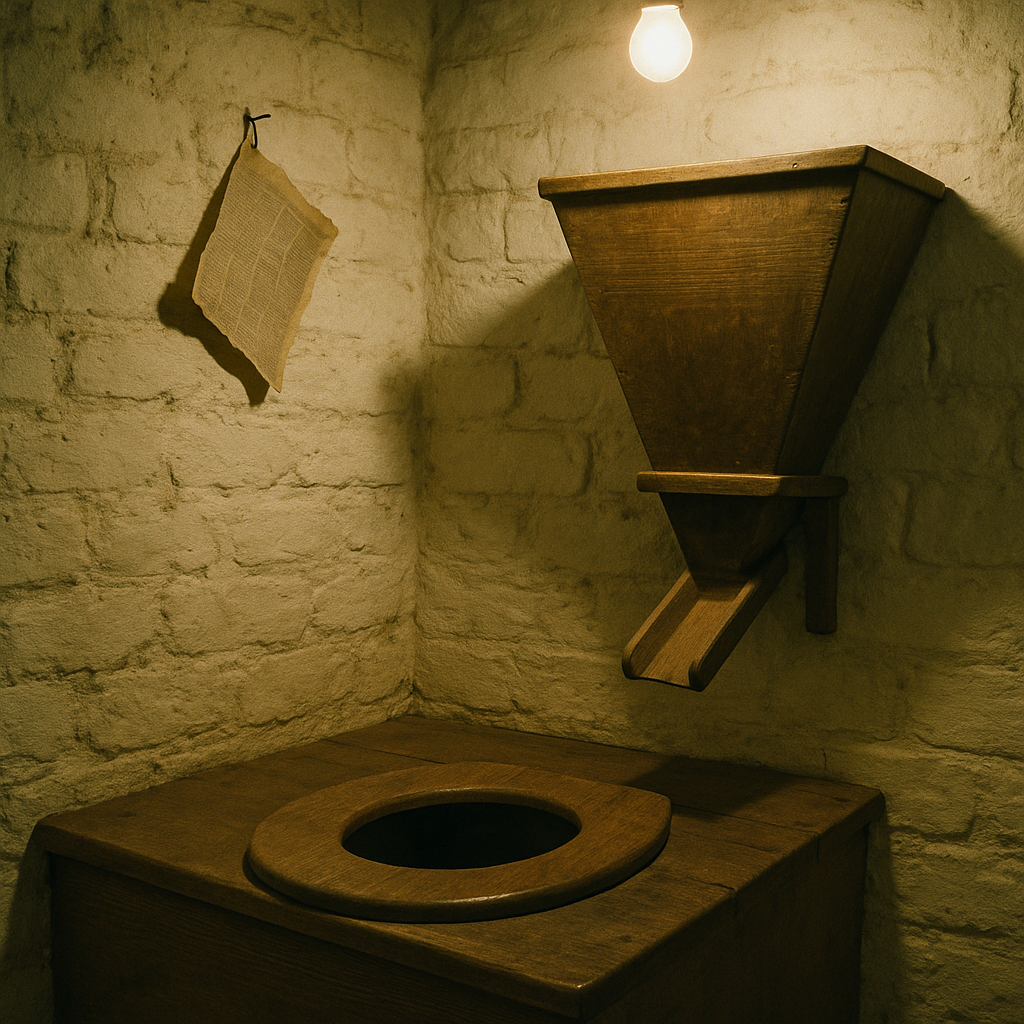
Into this gap stepped the earth closet, invented by Reverend Henry Moule of Fordington, Dorset, in 1860. Moule’s device was disarmingly simple: after use, a mechanical hopper released a measured quantity of dry earth or ash over the deposit, suppressing odour and beginning decomposition. The resulting material could go directly onto the garden. The earth closet was championed as a hygienic, cheap, and practical solution for areas without sewerage. Schools, hospitals, and working-class terraced houses across England adopted them. Thousands were installed in back yards throughout the Midlands, the North, and rural counties well into the Edwardian period.
The Twentieth Century Privy: Still There, Still Used
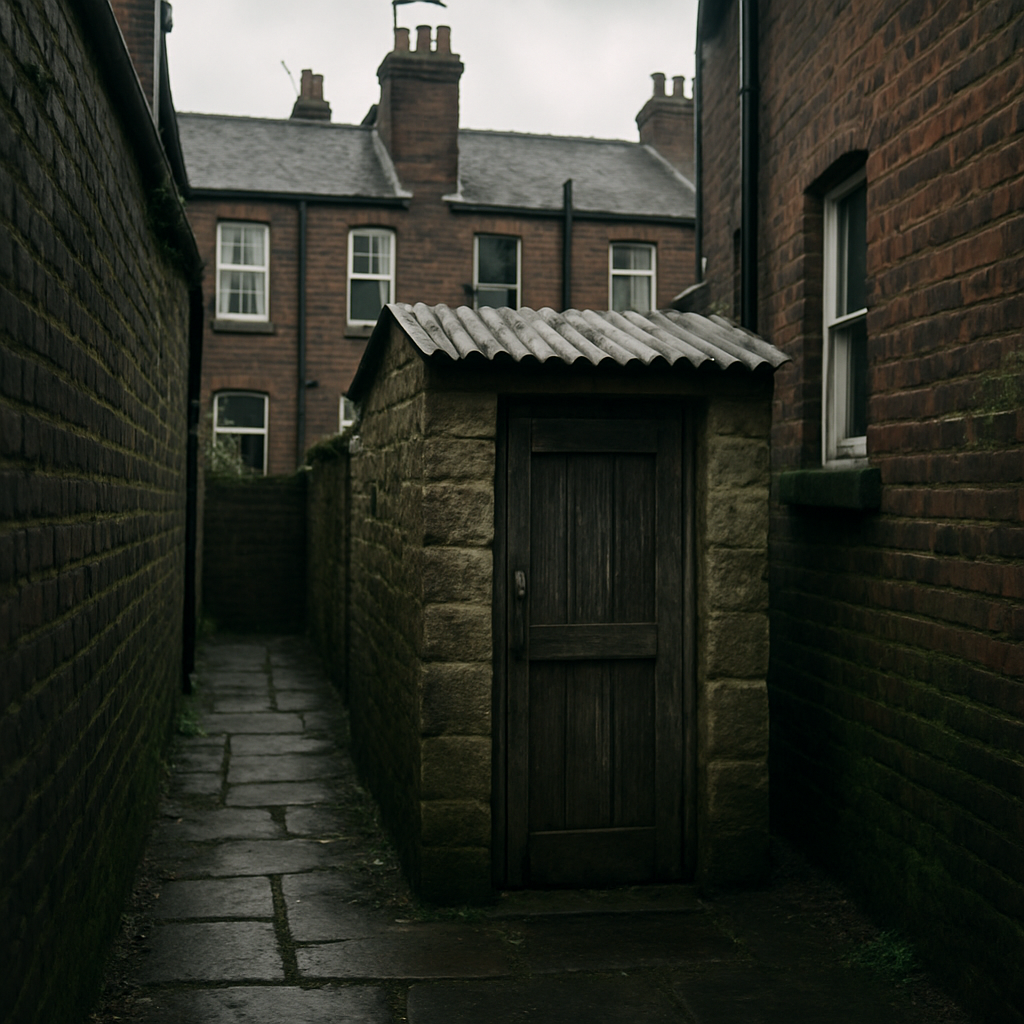
Here is the bit that tends to surprise people: the outside toilet did not quietly disappear with the Victorians. The 1951 census recorded that around forty per cent of English households still had no indoor bathroom or toilet. In older terraced streets in towns like Wakefield, Stoke-on-Trent, and Salford, the tin-roofed privy in the shared back yard remained the only option. Cold in winter, spidery all year round, and lit, if at all, by a candle or a single bare bulb run off a long cable from the kitchen.
Children in these houses grew up knowing the routine. The newspaper hung on a nail, torn into squares. The wooden seat scrubbed with carbolic soap. The bucket or pit below emptied by the night-soil collector, who still operated in some districts in the 1940s and 1950s. Slum clearance programmes, which accelerated after the Second World War, eventually demolished vast swathes of this housing stock. Council estates with indoor bathrooms replaced them. But it took time, and the transition was not complete until the 1970s and beyond in some rural areas.
The sanitation history of England maps almost perfectly onto class. Those who could afford it got clean water, indoor plumbing, and private bathrooms from the 1880s onwards. Those who could not, made do with the privy for decades longer. The outside toilet was not merely a historical curiosity; it was a marker of poverty and the pace at which the state was willing to invest in ordinary people’s health and dignity.
Hygiene, Bacteria, and the Lessons Still Relevant Today
The connection between poor sanitation and disease was not abstract. Cholera, typhoid, and dysentery killed in enormous numbers precisely because human waste contaminated the water supply and the immediate environment of the house. The bacteria thrived in the conditions that nineteenth and early twentieth century privies created: damp, dark, poorly ventilated, and rarely cleaned with anything effective. Understanding that specific germs caused specific diseases, rather than “miasmas” or bad air, was arguably the most important public health revelation of the Victorian age. You can read more about this history at the BBC’s Victorian health archive.
The legacy of that era is a deep British instinct around household cleanliness, and a wariness about what accumulates where it shouldn’t. Homeowners today remain vigilant about bacteria and germs around the exterior of the house in ways that would have baffled the night-soil man’s clients. Residents across Nottinghamshire, for instance, increasingly turn to specialists like The Bin Boss for professional wheelie bin cleaning, a service that tackles the bacteria and germs that accumulate in household bins. The environment around the back of a house, once the domain of the earth closet, is still a source of genuine concern about hygiene and cleaning. Details of their services can be found at thebinboss.co.uk.
The Victorian sanitation reformers would have recognised the impulse entirely. They spent decades arguing that the exterior of the house, the yard, the back lane, the communal areas, were as important to public health as the interior. Germs do not respect front doors.
The Bin Boss approach to cleaning wheelie bins reflects something the Victorians learnt the hard way: waste containers that are left dirty become a source of bacteria and bad smells that affect the whole house and the immediate environment. It is a mundane service by modern standards, and gloriously so compared to what came before it.
What Happened to the Old Privies?
Many were simply demolished when the houses they served were cleared. Others were converted into garden sheds, coal stores, or the domestic equivalent of a junk room. A surprising number still stand, identifiable by their brick construction, small size, and the faint ghost of their former purpose. In some parts of the East Midlands and the North, you can still spot them in the back yards of older terraced streets, now used for storing bicycles or garden equipment.
A handful have been preserved deliberately. The Beamish Museum in County Durham has reconstructed Victorian working-class streets in full, privy and all, giving visitors a genuine sense of what daily life looked and smelt like. The Black Country Living Museum does the same. These places are invaluable. The privy was not a marginal feature of English domestic life; for most people, for most of recorded history, it was the toilet. Full stop.
The outside toilet history of England, from the medieval privy to the earth closet and the stubborn survival of the back-yard lavvy well into the twentieth century, tells us something important about who this country chose to look after and when. The engineering was never the problem. The will, and the money, took rather longer to arrive.
Frequently Asked Questions
When did most English homes get indoor toilets?
The shift was gradual and uneven. Wealthier households in cities began installing indoor bathrooms and water closets from the 1880s onwards. However, the 1951 census found roughly forty per cent of English households still lacked an indoor bathroom or toilet. Many working-class terraced houses in northern and Midlands towns did not gain indoor plumbing until slum clearance programmes in the 1960s and 1970s.
What is the difference between a privy, an earth closet, and a cesspit?
A cesspit is an underground pit into which waste drains and accumulates, requiring periodic emptying by night-soil men. A privy is the outdoor structure housing the toilet seat above a pit or bucket. An earth closet is a specific Victorian invention by Reverend Henry Moule, which used a hopper to release dry earth over waste after each use, controlling odour and aiding decomposition without requiring water or sewers.
Why was the outside toilet still common in England in the 1950s?
Installing sewerage and indoor plumbing was expensive, and older terraced housing stock, particularly in industrial towns, was simply not built with the infrastructure to support it. Local authorities were slow to invest in slum clearance, and private landlords had little financial incentive to upgrade properties. Post-war council building programmes eventually replaced much of this housing, but the process took decades.
What were night-soil men and when did they stop working in England?
Night-soil men were workers who emptied cesspits and outdoor privies, typically operating after dark to avoid public nuisance. The collected waste was sold as agricultural fertiliser. In cities with new sewer networks the trade diminished from the 1860s onwards, but in smaller towns and rural areas night-soil collection continued well into the 1940s and, in isolated cases, the 1950s.