
Long before the age of motorised hearses and municipal cemeteries, the dead of rural England and Wales took one final journey along paths that had been worn into the landscape over centuries. These were the corpse roads: ancient, often unmarked routes that communities used to carry their deceased from remote hamlets to the nearest consecrated churchyard. The corpse roads of England’s history are not well signposted. You will not find them on tourist maps. But they are there, etched into the hillsides of Cumbria, threading through the Welsh uplands, crossing the moors of Yorkshire, and they come loaded with as much folklore and dread as anything Britain has produced.
Why Did Corpse Roads Exist in the First Place?
The answer lies in medieval parish law, which was rather unforgiving on the question of where you were allowed to be buried. Only the mother church of a parish held the right to conduct burials with full rites. Daughter chapels, estate churches, and remote oratories scattered across the countryside often lacked that privilege entirely. So if you happened to die in a far-flung farmstead two miles from the nearest track and six miles from the parish church, tough luck. Your family still had to get you there.
In the Lake District, for instance, the parish of Grasmere once covered a vast area of fells and valleys. Coffins were regularly carried on foot across the high passes, because there was simply no other option. The route from Mardale to Shap in what is now Cumbria is one of the most frequently cited examples: a brutal trek across open moorland, sometimes in appalling weather, with a dead body strapped to a litter and carried by relays of neighbours and family members. The path they used still exists, and locals have called it the Corpse Road ever since.
The Rules That Shaped Every Funeral Route
Parish church law was meticulous about burial rights, and disputes between churches over the income from burial fees were genuinely common. Churches charged for interment, and a busy parish could do rather well out of it. This gave mother churches a strong incentive to maintain their monopoly, and it gave rise to some peculiar customs around how corpse roads were used and maintained.
One rule that appeared in various forms across England was that a path used to carry a corpse became a public right of way. The logic, such as it was, ran like this: the dead had passed that way, and so the living had an inherent right to follow. Whether this was ever formally codified is debatable, but it shaped how communities thought about these paths and helps explain why some corpse roads survived as footpaths long after their original purpose had vanished. English Heritage and the Ramblers Association have both noted the overlap between ancient funeral routes and existing rights of way across England and Wales.
There were practical rules too. The coffin had to be carried on the right-hand side of any boundary. The procession must not deviate from the established route. Resting stones, flat slabs placed at intervals along particularly steep or long roads, were provided so the bearers could set down their load and catch their breath. Many of these stones survive, worn smooth and unremarkable, sitting beside footpaths in the Yorkshire Dales and the Welsh Marches without any label to explain what they once were.
The Lychgate: Where the Living Handed the Dead to the Church
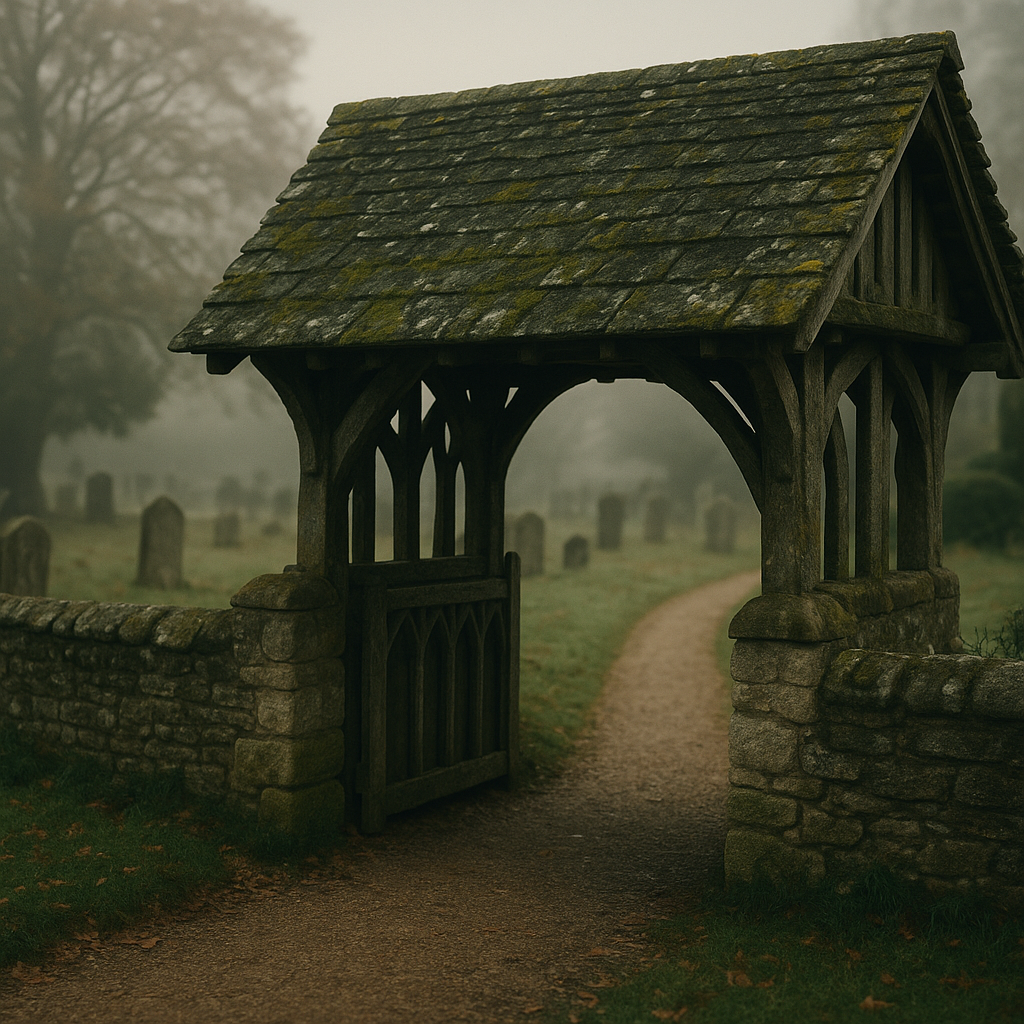
At the end of every corpse road stood the lychgate. The word comes from the Old English lic, meaning body or corpse, and the gate marked the boundary between the secular world and consecrated ground. It was a roofed gateway at the entrance to the churchyard, and its practical purpose was to provide shelter for the coffin and the mourners while they waited for the priest to arrive and formally receive the body.
Some lychgates are genuinely ancient. The one at St Mary’s in Bray, Berkshire, is thought to date to the fifteenth century. Others were rebuilt during the Victorian Gothic revival, when antiquarian sentiment suddenly made the old furniture of parish life fashionable again. Either way, the lychgate served as a transitional space, a threshold between the world of the living and the territory of the dead. Standing under one on a grey afternoon, you can still feel something of that weight.
Folklore, Phantom Funerals, and the Fear of the Dead
The corpse roads of England and Wales generated folklore in extraordinary quantities, and most of it was rooted in a single anxiety: the restlessness of the dead. Across rural communities, it was widely believed that the spirit of a dead person lingered near its body until burial, and that it was capable of mischief, malevolence, or simple grief-stricken wandering if the burial was delayed or improperly conducted.
One of the most persistent traditions was the toili in Welsh culture, sometimes anglicised as the phantom funeral or corpse candle. Witnesses claimed to see a spectral procession moving along a known corpse road at night, carrying a coffin and accompanied by flickering lights. These lights, the canwyll corff or corpse candles, were said to predict a death and trace the exact route the real funeral would later take. Dafydd Llwyd ap Llywelyn ap Gruffudd, a fifteenth-century Welsh poet, referenced them, and accounts collected by Victorian folklorists suggest the belief was still very much alive in rural Wales into the nineteenth century.
In the north of England, particularly in Northumberland and the Yorkshire Dales, the fear was slightly different. Here the worry centred on the idea that a spirit might become confused and haunt the wrong place if the body was not carried along the correct, established route to its churchyard. Deviate from the corpse road and you risked leaving something behind. It sounds fanciful, but this belief had real practical consequences: communities were sometimes deeply reluctant to establish new routes, even when old ones had become difficult or dangerous to use.
You can read more about the folklore traditions of rural Britain and their roots in parish life through the BBC’s History of Britain resources, which cover the medieval religious structures that shaped these customs.
Where Can You Still Walk a Corpse Road Today?
More places than you might expect. The Old Corpse Road between Haweswater and Shap in Cumbria is one of the most well-known, and it remains a challenging but rewarding walk across open fell country. In Wales, the Sarn Helen Roman road overlaps in places with much older funeral routes through the Brecon Beacons. Dartmoor has several candidates, though they tend to be poorly documented compared to their northern counterparts.
The Peak District too has its share. The route from Edale across the moors towards Hope is often cited, and the string of resting stones along the way lend it a mournful authenticity. The Ramblers Association has mapped many of these paths as ordinary rights of way, which means they are perfectly legal to walk, even if most people doing so have absolutely no idea what the path was once used for.
A Landscape Shaped by the Dead
There is something quietly remarkable about the fact that the dead shaped the English and Welsh countryside in this way. The routes they were carried along became public paths. The gates built to receive them became landmarks. The folklore that grew up around those journeys became part of the cultural fabric of rural communities, passed down through generations until it faded into ghost story territory and then, eventually, into near-total obscurity.
The corpse roads of England’s history deserve better than that. They are a record of how seriously pre-industrial communities took the business of death and how much effort, physical and spiritual, they invested in getting it right. Next time you are walking an unmarked moorland path and you come across a flat stone sitting at the edge of the track with no obvious purpose, you might be standing at one of those old resting places. Worth a moment’s pause, I think.
Frequently Asked Questions
What is a corpse road in England?
A corpse road is an ancient rural route used to carry the bodies of the deceased from remote farmsteads and hamlets to the nearest consecrated churchyard for burial. They were common across England and Wales during the medieval period, when only mother churches held the right to conduct full burial rites.
Where can I walk a corpse road in the UK?
One of the most famous is the Old Corpse Road in Cumbria, running between Haweswater and Shap across open moorland. Other notable examples can be found in the Peak District, the Yorkshire Dales, Dartmoor, and rural Wales. Many survive today as ordinary public footpaths and rights of way.
What is the difference between a corpse road and a lychgate?
A corpse road is the route taken to carry the body to the churchyard, while a lychgate is the roofed gateway at the entrance to the churchyard where the coffin rested and the mourners waited for the priest. The word ‘lych’ comes from the Old English word for body or corpse.