
There is something quietly heartbreaking about a crumbling lido. The peeling paint on the diving board, the cracked tiles around an empty basin, the ghost of a tannoy system that once announced swimming galas on a warm August afternoon. British lidos were, for a few glorious decades in the twentieth century, the very soul of the British summer. Municipally funded, architecturally ambitious, and thoroughly egalitarian, they gave entire generations somewhere to splash about without needing a train fare to the coast. Then, one by one, most of them simply closed.
What Exactly Is a Lido?
The word comes from the Italian, via the famous Lido di Venezia, a sand bar near Venice that became synonymous with outdoor bathing in the nineteenth century. In Britain, it came to mean an outdoor, often municipally run, swimming pool, typically larger than anything you’d find indoors and frequently dressed up in the architectural language of its era. The British lido movement really took hold in the 1930s, when local councils across England and Wales embarked on ambitious building programmes fuelled by a belief that fresh air, exercise, and cold water were the proper antidotes to urban poverty and ill health.
At their peak, there were well over 300 open-air public pools in England alone. By the turn of the millennium, that number had collapsed to fewer than 100, and the decline hasn’t fully stopped. Brockwell Lido in Lambeth, Saltdean Lido in Brighton, and the Jubilee Pool in Penzance are among the survivors, each one a stubborn, beautiful remnant of an era when civic ambition expressed itself in concrete and chlorine.
The Art Deco Heyday of British Lidos
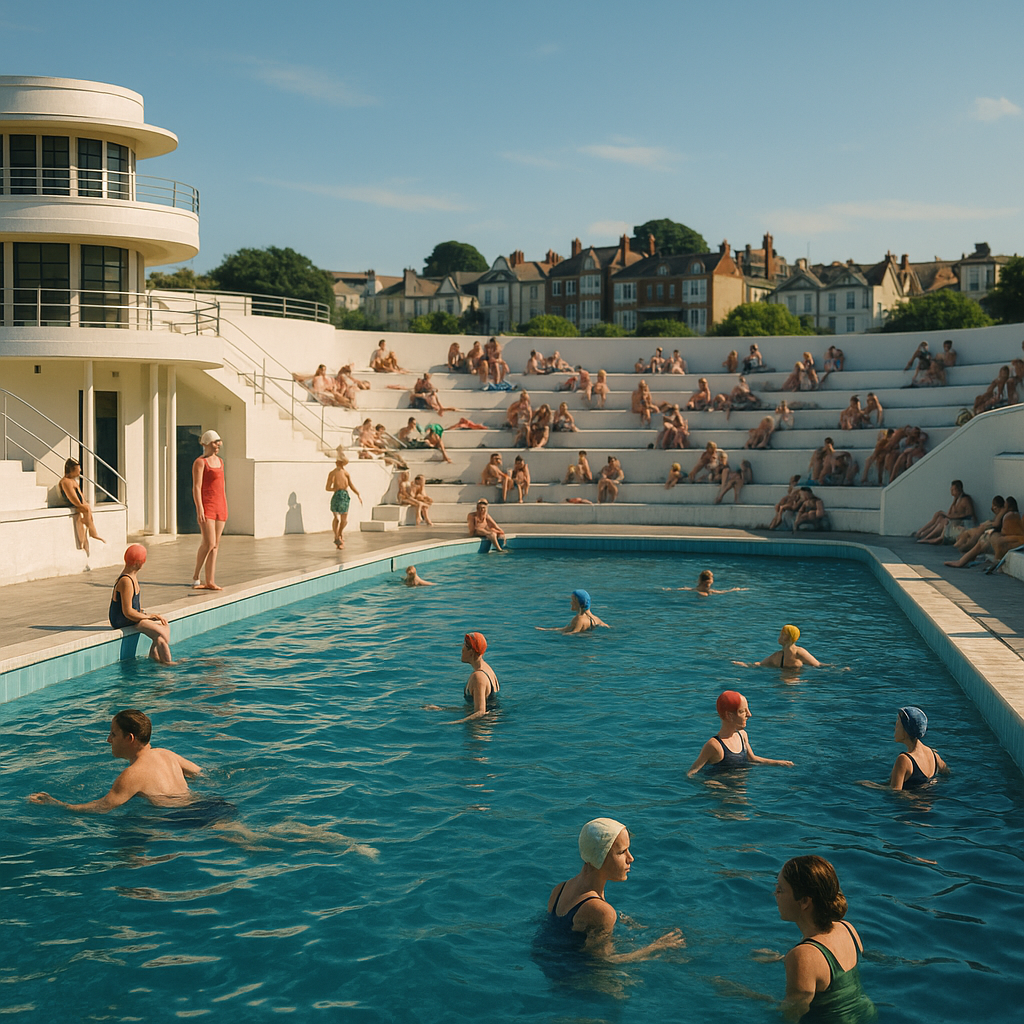
The 1930s were the golden age. Between 1930 and 1939, more lidos opened in Britain than in any other decade before or since. The architectural style of choice was art deco: curved white walls, geometric tile patterns, streamlined changing block facades, and sunbathing terraces that managed to feel genuinely glamorous even in Rotherham. The Jubilee Pool, opened in 1935 in Penzance, remains one of the finest surviving examples of art deco lido design in Europe. It sits right on the sea front, triangular in form, with its tiered white promenades catching the Cornish light in a way that still stops people in their tracks.
Saltdean Lido, also opened in 1938, is a Grade II* listed building, a status it shares with only around 5.5 per cent of all listed structures in England. Its sweeping curves and first-floor sun deck terraces were the work of architect R.W.H. Jones, and they represent civic ambition at its most assured. The lido wasn’t just a pool; it was a statement that ordinary people deserved beautiful things.

Why Did So Many British Lidos Close?
The short answer is money, but the longer answer is more interesting. Post-war austerity bit hard, and outdoor pools were expensive to maintain. The rise of the package holiday from the 1960s onwards, with cheap flights to Majorca and the Algarve, meant the domestic outdoor pool lost its central place in British leisure culture. Why queue in the drizzle for the Droitwich Lido when you could be sitting by an actual Mediterranean pool?
Indoor leisure centres, often built with Arts Council funding in the 1970s and 1980s, offered heated, weatherproof alternatives. Councils, already squeezed by rate-capping and later by the restrictions that followed the Local Government Finance Act, found it easy to justify closing outdoor pools that ran at a loss for eight months of the year. By the 1990s, closures were happening almost monthly. Pools that had been the beating heart of their communities were drained, fenced off, and left to moss and pigeons.
Some were demolished outright. Others lingered in a state of semi-dereliction. A few, through luck and extraordinary community effort, survived into the present day.
The Campaign to Save Britain’s Surviving Lidos
What has changed in recent years is the ferocity of the response. Communities across England have mobilised to rescue lidos that local authorities have been unable or unwilling to maintain. The tools available to them have never been sharper: crowdfunding platforms, social media, heritage listing applications, and well-organised campaign websites that can generate thousands of signatures overnight.
Historic England has played a significant role, adding several lidos to its Heritage at Risk register and pushing for listed building consent processes that make casual demolition much harder. The Historic England Heritage at Risk programme monitors over 5,000 sites nationally, and lidos have featured prominently in recent years. The attention matters. It gives campaigners a legitimate institutional argument to make when councils start talking about redevelopment.
The Brockwell Lido Trust in south London is one of the most successful examples of community-led heritage revival. The lido, which first opened in 1937, is now run by a charitable trust and welcomes tens of thousands of swimmers every year, including a devoted open-water swimming community that treats a January dip in Brixton as a point of personal pride. Year-round membership has surged since the pandemic, when outdoor exercise became not just fashionable but essential.
What a Restored Lido Can Mean for a Community
The economic and social case for lido restoration is stronger than it has ever been. Research into community sports infrastructure consistently shows that facilities with low or no admission costs reduce health inequalities in meaningful ways. Outdoor swimming has been linked to reduced anxiety and depression, and it draws people together across income brackets in a way that private gyms simply do not.
There is also the tourism angle. The Jubilee Pool in Penzance, restored and reopened after a major storm in 2018, now draws visitors from across the country, many of whom come specifically to swim in a geothermally heated pool inside a listed art deco structure on the edge of the Atlantic. That is, frankly, a remarkable thing to be able to say about a municipal facility in Cornwall.
Which British Lidos Are Still Worth Visiting?
Tooting Bec Lido in south London is the largest open-air freshwater pool in England, holding 1.35 million litres of unheated water. It opens in May and runs through to September, and on a warm day it has an atmosphere that is entirely its own. Hathersage Pool in Derbyshire sits in the Peak District with views of the surrounding moors that make even a cold swim feel somehow worth it. Hampton Pool in Richmond upon Thames is heated, which makes it a near year-round proposition, and it has been community run since 1985.
Each of these surviving British lidos carries the DNA of that original 1930s ambition: the democratic belief that a bit of sun and water is everyone’s right. The ones that remain are not just swimming pools. They are listed monuments, community assets, and stubborn bits of evidence that when people care enough about something, they will fight like mad to keep it.
Britain built its lidos out of optimism. The best of them survive because that optimism turned out to be contagious.
Frequently Asked Questions
How many lidos are left in England?
Estimates vary, but there are thought to be fewer than 100 outdoor public swimming pools still operating in England, compared to over 300 at their peak in the mid-twentieth century. Many survivors are run by community trusts rather than local councils.
What is the oldest lido still open in the UK?
Tooting Bec Lido in south London, which opened in 1906, is one of the oldest surviving outdoor pools in the country. It holds 1.35 million litres of unheated fresh water and remains open to the public each summer.
Why were British lidos built in the 1930s?
The 1930s lido boom was driven by local council investment in public health, combined with a cultural enthusiasm for fresh air and outdoor exercise. The art deco architectural style of the era produced many of the most striking lido designs, which blended civic ambition with genuine aesthetic flair.
Are British lidos protected by listed building status?
Several surviving lidos are listed buildings. Saltdean Lido in Brighton holds Grade II* listed status, and the Jubilee Pool in Penzance is also listed. Historic England’s Heritage at Risk register has flagged a number of lidos as priorities for preservation.
Can you swim in British lidos all year round?
Most outdoor lidos in England operate seasonally from May to September, though heated pools like Hampton Pool in Richmond upon Thames are open for much of the year. Open-water swimming clubs connected to some lidos do swim year-round, but general public access is typically seasonal.