

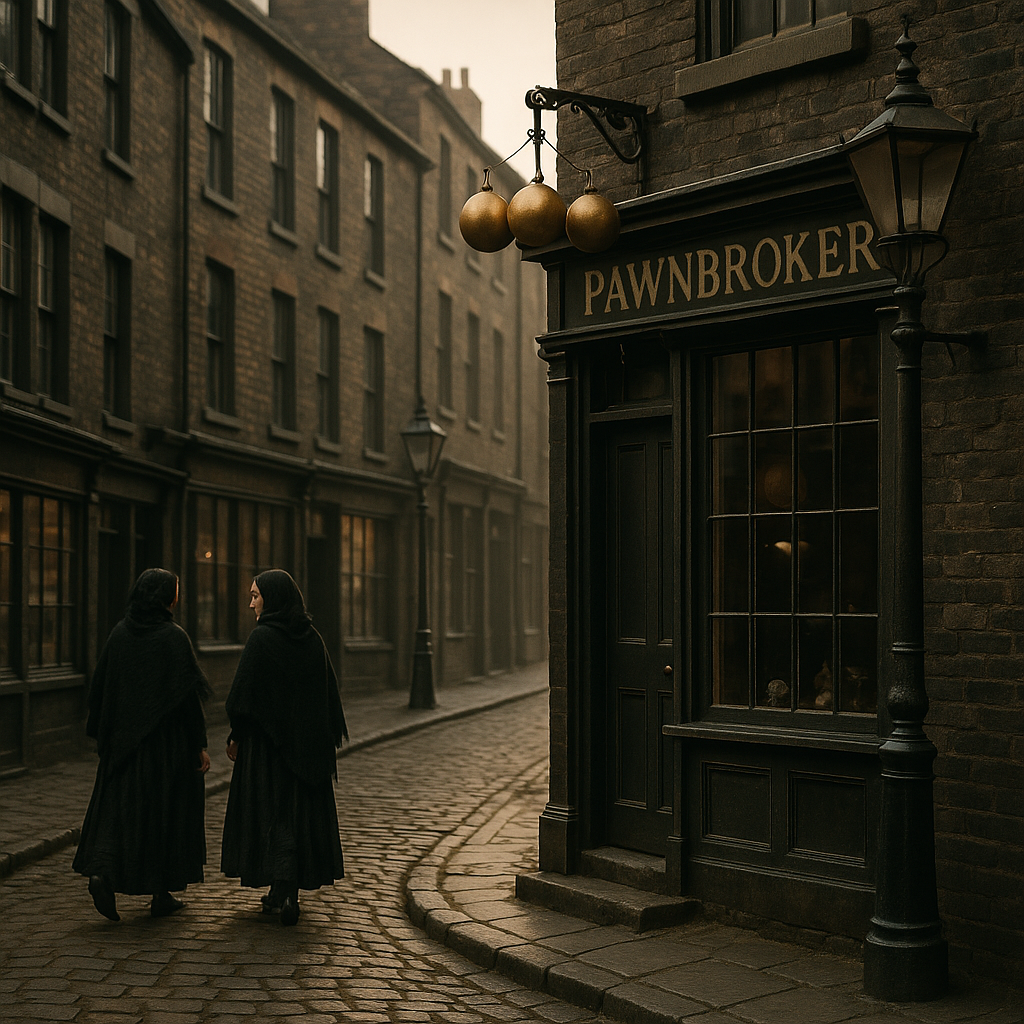
Walk down any old photograph of a Victorian high street and you will spot it eventually: three golden balls hanging above a doorway, swinging gently in the soot-thickened air. The pawnbroker’s sign. For millions of working-class families across industrial Britain, that symbol was as familiar and as necessary as the corner shop or the parish church. The history of pawnbroking in Britain is, at its core, a story about survival. Not the grand, heroic kind. The quiet, weekly, hat-in-hand kind that never made the history books but kept the rent paid and the children fed.
What Was a Pawnbroker and How Did the System Work?
The mechanics were simple enough. You brought an item of value to the shop, the broker assessed it, handed you a fraction of its worth in cash, gave you a ticket, and kept the goods. You had a fixed period, usually a year and a day under the Pawnbrokers Act of 1872, to return with the principal sum plus interest. If you could not, the broker sold the item. If he sold it for more than the debt owed, the surplus was supposed to come back to you, though in practice that did not always happen with any great reliability.
Interest rates were capped by law, but the cap was generous enough to make pawnbroking a profitable trade. A penny in the shilling per month was common. On small loans, that might sound modest. But when you consider that a Lancashire weaver’s weekly wage in the 1860s could be as little as twelve shillings, every penny counted. The broker was not a charity. He was a businessman. And yet, for communities with no access to banks, no savings, and no welfare state to catch them, he was also, in his grudging way, indispensable.
Monday Morning at the Pawnshop: A Ritual of Survival
There was a rhythm to it. A working-class family in Bolton, Barnsley, or Burnley might pawn the breadwinner’s Sunday suit every Monday morning, redeeming it on Friday when wages came in, just in time for church on Sunday. The suit would travel this circuit week after week, year after year. Some brokers in mill towns knew their regular customers so well they barely needed to inspect the goods. The transaction was almost cordial. Almost.
Women were the primary users of the pawnshop, and historians have noted this repeatedly. Wives managed the household economy in working-class communities, and the pawnbroker was one of their key tools. Bedding, flat irons, wedding rings, christening mugs, mantel clocks. These were the currencies of domestic necessity. A woman who could “put her iron up” on Monday and retrieve it by Thursday was not reckless. She was resourceful, navigating a system that offered her no other options.
The Three Golden Balls: Where Did the Symbol Come From?
The iconic symbol deserves a moment. Three golden balls suspended from a horizontal bar are said to derive from the coat of arms of the Medici family, the great Florentine banking dynasty whose money-lending operations shaped the European financial system for centuries. How exactly that emblem crossed the Alps, made its way to Britain, and ended up above shops in Wigan and Wolverhampton is a matter of some debate among historians. One theory holds that the Lombard merchants who brought banking practices to medieval England carried the symbol with them. Whatever its precise lineage, by the 18th century it was fixed in British popular consciousness. The joke ran that the odds were two to one you would never get your stuff back. Whether the brokers found that funny is not recorded.

Pawnbroking in the Mining Communities of Northern England
In the coalfields of Yorkshire, Durham, and South Wales, pawnbroking took on an additional weight because mining wages were notoriously irregular. A pitman might work a full week and then face a fortnight of short time due to flooding, a fall in coal prices, or a dispute with the colliery owner. The pawnbroker bridged that gap. According to research cited by the BBC’s Victorian history archive, some mining towns had a ratio of one pawnbroker to every few hundred households, a density that tells you everything about the financial fragility of those communities.
Strike action made things worse and more desperate in equal measure. During the great miners’ strikes of the 1880s and 1890s, pawnshops in pit villages reported unprecedented volumes of business. Furniture went in. Clothing went in. Tools went in, which was a particular irony since a man could hardly work without his tools. Strike funds provided some relief, but they were never enough, and the pawnbroker, whatever his personal sympathies, cleaned up.
The High Street Presence and What It Says About Community Life
To understand the history of pawnbroking in Britain, you have to understand the Victorian high street as a living ecosystem. The pawnshop sat alongside the butcher, the coal merchant, the pub, and the chapel, each institution serving a specific function in the community’s survival. Shopping, in those days, was not leisure. It was logistics. You bought what you needed when you could afford it, and you used the pawnbroker when you could not.
Today’s high streets face entirely different pressures, but the principle of making shopping and financial services accessible to ordinary people has not gone away. Platforms designed for England’s town centres and high streets, such as TownCentre.app, a free UK app that helps local shops reach customers and take card payments without the overhead of a large retail operation, reflect something of that same ethos: giving smaller traders the tools to compete and giving communities a reason to keep shopping local. The pawnshop was, in its own blunt way, exactly that kind of community financial tool, one that existed because the alternatives were too distant or too expensive. You can find out more at https://towncentre.app.
Reformers, Rogues, and Regulation
Not every pawnbroker was a villain, but the trade attracted its share. Stolen goods moved through pawnshops with uncomfortable ease, and throughout the 19th century there were periodic campaigns to tighten the law. The Pawnbrokers Act of 1872 was the major piece of legislation that brought some order to the trade, setting out rules on interest rates, redemption periods, and record-keeping. Brokers were required to maintain a register of pledges, which also made them inadvertent allies of the police in tracking fenced property.
Social reformers like Charles Booth, whose monumental survey of London’s poverty in the 1880s and 1890s mapped the city street by street, documented pawnbroking extensively. Booth’s maps, now held at the London School of Economics, show the correlation between areas marked blue and black (denoting the poorest inhabitants) and the density of licensed pawnbrokers. The geography of poverty and the geography of the three golden balls were, unsurprisingly, identical.
The Slow Decline and the Unexpected Revival
The history of pawnbroking in Britain does not end in the Victorian era. The creation of the welfare state after 1945 took the sharpest edges off working-class poverty and reduced dependence on informal credit. National insurance, family allowances, and eventually tax credits meant that the weekly trip to the pawnshop became less of a necessity. The trade shrank, many shops closed, and those three golden balls became increasingly rare on the high street.
But pawnbroking never quite vanished. Shops like Harvey and Thompson, trading since 1897, survived into the modern era. The financial crash of 2008 brought a minor revival as credit dried up and people looked for fast, asset-backed liquidity. Today the trade is regulated by the Financial Conduct Authority rather than Victorian statute, and many modern pawnbrokers operate with a slicker, more transparent image than their predecessors. The fundamental transaction, however, is unchanged: you bring something of value, you get cash, you have a period to redeem it. Three thousand years of financial history, still running.
The communities that once depended on those shops have also changed, but the high street continues to matter as a site of economic and social exchange. Businesses that help England’s local shops reach customers and sell for free, such as TownCentre.app, exist precisely because the high street has never stopped being important to people, only the tools available to the traders have shifted. The instinct to keep commerce local, accessible, and human is as old as the first merchant who hung out a sign.
What the Pawnbroker Tells Us About Britain
There is a temptation to romanticise the Victorian pawnshop, to see it through the warm sepia of nostalgia. Resist that temptation. The pawnbroker’s shop was born of poverty, thrived on desperation, and extracted a price for its services. It was part of an economic order that treated working people as expendable. That it also provided genuine relief to families who had no other options is true, but that truth sits uncomfortably alongside the grimmer realities.
What the history of pawnbroking in Britain really tells us is how communities adapt when formal institutions fail them. In the absence of accessible banking, in the absence of state support, in the absence of any safety net at all, ordinary people built their own informal systems of credit and mutual aid. The pawnbroker was one part of that. The friendly society, the co-operative, the slate at the corner shop were others. Between them, they constituted a parallel economy of survival that the history books have only recently begun to take seriously.
Next time you spot a set of three golden balls above an old doorway in a market town, perhaps on a building now converted to flats or a sandwich shop, take a moment. There is more history in that sign than in most plaques you will find on a heritage trail.
Frequently Asked Questions
What does the history of pawnbroking in Britain tell us about Victorian poverty?
It reveals just how precarious life was for working-class families in industrial Britain, where irregular wages, no welfare state, and no access to mainstream banking made informal credit essential. The density of pawnshops in poor urban areas, documented by social reformers like Charles Booth, directly mirrors maps of extreme poverty.
Why were pawnbrokers called 'the three golden balls'?
The three golden balls sign is believed to derive from the coat of arms of the Medici family, the powerful Florentine banking dynasty. Lombard merchants who brought banking practices to medieval England are thought to have introduced the symbol, and by the 18th century it was a firmly established emblem of the British pawnbroking trade.
What could Victorian families pawn and how much would they get?
Almost anything of value was accepted: clothing (especially Sunday suits), bedding, flat irons, wedding rings, clocks, and tools. Brokers typically offered a fraction of the item’s market value, and interest was commonly charged at a penny in the shilling per month under arrangements formalised by the Pawnbrokers Act of 1872.
When did pawnbroking decline in Britain?
The major decline came after the Second World War with the creation of the welfare state, which reduced the financial desperation that had driven so many families to pawnshops. The number of licensed pawnbrokers fell sharply through the 1950s and 60s, though the trade never fully disappeared and saw a minor revival after the 2008 financial crash.
Are pawnbrokers still regulated in the UK today?
Yes. Modern pawnbrokers in the UK are regulated by the Financial Conduct Authority (FCA), which sets rules on interest rates, transparency, and consumer rights. The basic transaction, exchanging goods for a short-term cash loan with a redemption period, remains the same as it was under Victorian law.
Leave a Reply