
Monday was not a day of rest in the nineteenth-century working-class home. It was a day of steam, sore hands, and sheer physical graft. Victorian washday history in England is one of those subjects that sounds domestic and therefore dull, until you realise it was arguably the hardest single day in the working week for millions of women across the country. It consumed most of Monday, often bled into Tuesday, and the preparation for it started on Sunday night. The clothes did not wash themselves, the copper did not light itself, and nobody was coming to help.
Why Monday? The Social Rules Behind the Washday Calendar
The choice of Monday was not arbitrary. It had hardened into something close to law by the mid-Victorian period, governed less by practicality than by neighbourhood expectation. A woman who hung her washing out on a Tuesday was the subject of gossip. A Thursday line full of sheets raised eyebrows. Monday was washday because it had always been Monday, and in tightly packed terraced streets, the back-to-back rows of Nottingham, the mill towns of Lancashire, the colliery rows of County Durham, social conformity moved fast.
There was a practical logic beneath the convention, too. Sunday was the day you wore your best clothes to chapel or church. Monday therefore brought the dirtiest laundry of the week: Sunday best that had been worn, work clothes from the previous week, and bed linen that had accumulated since the last wash. Better to clear the lot at the start of the week, leaving the house in order by Wednesday or Thursday. At least, that was the theory.
The Copper Boiler: Heart of the Victorian Washday
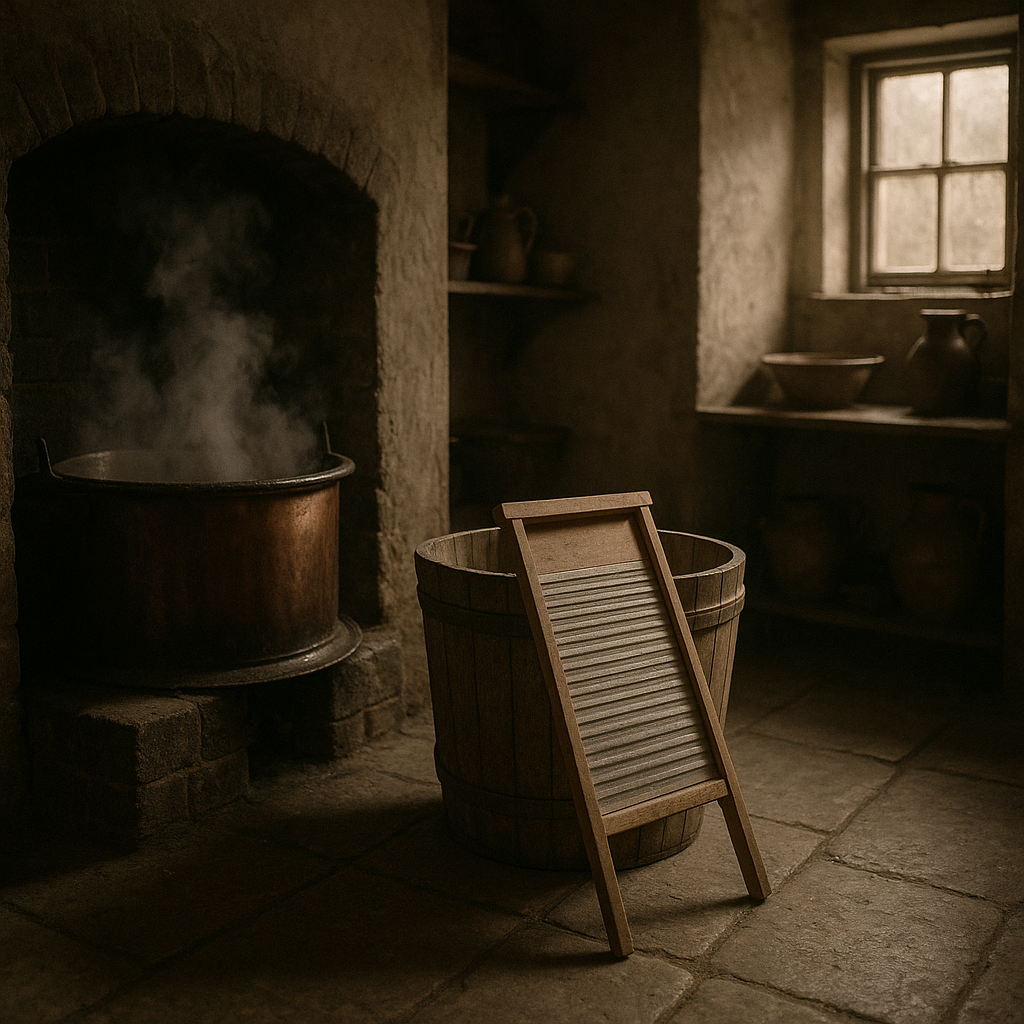
The copper was the centrepiece of the whole operation. Built into a corner of the scullery or the outhouse, it was a large rounded vessel, usually made of copper or later galvanised iron, set over a small brick firebox. You filled it from the pump or the tap, loaded it with wood or coal, and waited. Heating enough water to do a proper wash could take the better part of an hour.
Soap came in hard bars, often Sunlight Soap after Lever Brothers introduced it in 1884, and was cut or grated into the boiling water. Whites went in first, coloured items later to avoid the dye running. Everything had to be pounded and stirred with a wooden dolly, a heavy implement that looked something like an upended three-legged stool on a long handle. Dolly tubs were often made of zinc. The physical effort of working a dolly for an hour or more was considerable, particularly for women who were already managing children, cooking, and any number of other household duties alongside.
Some households used a posser instead of a dolly, a metal or wooden cone with holes, pushed up and down through the water to agitate the clothes. Either way, the work was relentless. Steam filled the scullery. The floor got wet. The smell of lye and boiling linen hung in the air all day.
The Mangle: Where the Real Strength Was Needed
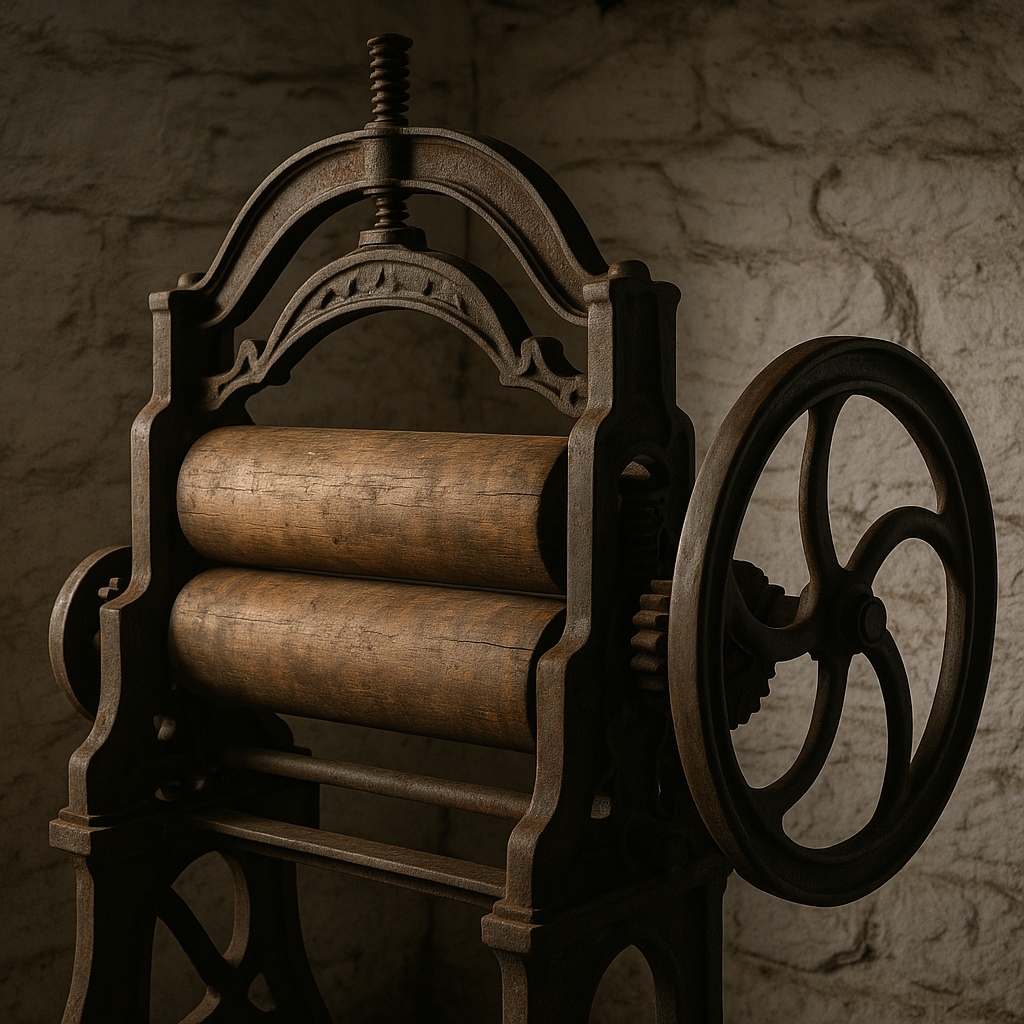
Getting the water out was almost as hard as getting the dirt out. The mangle, that great cast-iron machine with its two wooden rollers and a heavy hand-turned wheel, was the answer. Wet clothes were fed through the rollers, which squeezed out the bulk of the water, and the process had to be repeated several times for thick items like blankets and moleskin trousers.
The mangle was also a neighbourly institution of sorts. Not every household owned one. Cheaper mangles from the 1870s onwards made them more accessible, but in poorer streets it was common for one woman to own a decent mangle and to charge a small fee, or simply accept a favour in return, for its use. This created a minor economy of washday reciprocity that ran up and down the back entries of Victorian working-class neighbourhoods.
Wringing by hand was the alternative, and it left women’s wrists and forearms visibly swollen by the end of the day. Victorian social historians at the BBC have noted that washday injuries, scalds from the copper, strained muscles from the mangle, and chilblains from rinsing in cold water, were among the most common domestic ailments reported to parish doctors in the period.
Starch, Blue, and the Art of Finishing
Washing was only the beginning. Once dried on the line, or, in wet weather, draped over racks around the kitchen range, the laundry required finishing. Starch was mixed and applied to collars, shirt fronts, and aprons to give them that stiff, presentable look considered essential for respectable working families. Dolly blue, a small blue bag swirled through the final rinse water, was used to counteract the yellowing that boiling caused in white cotton. Flat irons, heated on the range and tested on a damp cloth before use, finished the job.
The whole process, from lighting the copper on Monday morning to pressing the last collar on Tuesday afternoon, could span two days. Women in domestic service faced the same schedule but on a vastly larger scale, washing for entire households without any of the household’s female members lifting a finger.
What the Washing Line Told Your Neighbours
The state of a woman’s washing line was a public declaration of domestic competence. Dingy whites, a slow drying line, or, worst of all, washing that went out late were all read as evidence of poor housekeeping. In the cramped terraced streets of Victorian England, where the backs of houses faced each other across narrow yards, there was no privacy. Everyone could see your sheets.
This is one of the reasons window treatments mattered so much in the Victorian home. Net curtains allowed a degree of modesty; heavier drapes could shield the interior from the inevitable scrutiny of close-knit streets. The relationship between home style and privacy has deep roots in English domestic history. Homeowners today renovating older terraced properties often rediscover this instinct when thinking about window coverings during a home refurbishment. Based in Mansfield, Nottinghamshire, Vesta Blinds and Shutters Mansfield supplies and fits a wide range of blinds, from roller blinds and vertical blinds to perfect fit and pleated options, to homeowners who want the same combination of privacy and style that Victorian households were reaching for with their lace panels. You can find out more about their range at vestablinds.com.
The Decline of the Monday Washday
The tradition began to loosen its grip from the early twentieth century onwards, though slowly. The first domestic washing machines appeared in Britain before the First World War, but they remained expensive novelties for decades. It was the post-war period, and particularly the widespread adoption of the twin-tub and then the automatic washing machine through the 1950s and 1960s, that finally broke Monday’s stranglehold on the working-class week.
By the time the twin-tub had become standard in council house kitchens, the copper boiler was a relic and the dolly tub had been relegated to the allotment shed. The mangle survived somewhat longer as a garden ornament than as a working tool. The strict social calendar that governed Victorian washday history in England dissolved alongside the shared physical ordeal that had enforced it.
What remained was the instinct for order in the home. The desire to keep a house presentable, to manage how it appeared from the outside as much as the inside, did not go away. It simply expressed itself differently: in the choice of paint colours, in the style of net curtain, in whether you went for roller blinds or venetian blinds when renovating a Victorian terrace. Vesta Blinds and Shutters Mansfield, whose range includes venetian blinds, roller blinds, and perfect fit styles suited to the proportions of older homes, has seen consistent demand from homeowners working through renovations of precisely these kinds of properties across Nottinghamshire and beyond.
The Monday washday is long gone. The copper has been cold for the best part of a century. But the rhythms it imposed on the English working-class home, the pride in cleanliness, the anxiety about appearances, the fierce domestic competence expected of women, left marks that lasted far longer than the institution itself.
Frequently Asked Questions
Why was Monday traditionally washday in Victorian England?
Monday became washday by widespread social convention across working-class England. It made practical sense to wash on Monday because Sunday’s best clothes had just been worn and needed cleaning, and clearing the laundry early in the week left the home settled by the weekend. Deviating from Monday was considered a sign of poor domestic organisation.
What was a copper boiler used for on Victorian washday?
The copper boiler was a large metal vessel set over a small brick firebox, built into the scullery or outhouse. It was filled with water, heated with coal or wood, and used to boil laundry with soap. Whites went in first, and the clothes were agitated with a wooden dolly or posser to loosen dirt.
How did a Victorian mangle work?
A mangle used two heavy wooden rollers turned by a hand-cranked iron wheel. Wet laundry was fed through the rollers, which squeezed out the bulk of the water far more efficiently than hand-wringing. Not every household owned one, and in many Victorian streets neighbours would share a mangle for a small fee or returned favour.
What was dolly blue used for in Victorian laundry?
Dolly blue was a small bag of blue dye swirled through the final rinse water when washing white cotton and linen. Boiling laundry in a copper tended to turn whites yellowish over time, and the faint blue tint from dolly blue counteracted this yellowing, making the finished laundry look brighter and cleaner.
When did the Monday washday tradition end in England?
The tradition weakened significantly after the Second World War as electric washing machines became more affordable. The twin-tub became common in British households through the 1950s and 1960s, removing the need for the copper boiler and the mangle. By the late 1960s, the strict Monday washday calendar had largely disappeared from everyday working-class life.