Few institutions are as deeply woven into the fabric of British life as the local pub. The word itself is practically a national heirloom. The history of British pubs stretches back nearly two thousand years, running like a golden thread through Roman occupation, medieval village life, Georgian industrialisation, and right into the craft beer revolution of the twenty-first century. It is a story of community, commerce, warmth, and the simple human desire to sit somewhere comfortable with a decent pint in hand.
Roman Roots: Where It All Began
Before there was a “local”, there was the taberna. When the Romans arrived in Britain around 43 AD, they brought with them a culture of roadside drinking establishments that served soldiers, merchants, and travellers making their way along the newly built road network. Archaeological digs at sites including Wroxeter and Verulamium (present-day St Albans) have uncovered evidence of these early establishments: stone counters, ceramic drinking vessels, and even rudimentary drainage. These were not cosy retreats with sticky carpet and a fruit machine in the corner. They were functional watering holes, built for practicality rather than pleasure. But the seed was planted.
Medieval Ale Houses and the Rise of the Inn
After the Romans departed, the tradition did not vanish. It simply became more local, more domestic. By the early medieval period, the ale house had become a common feature of English village life. These were typically private homes where the occupant, often a woman known as an ale wife, brewed ale and sold it from the front room. Ale was not merely recreational. With water sources frequently contaminated, ale was safer to drink than most alternatives, making the ale house something close to a public health service. A rough-hewn sign, often a pole with a bush of greenery attached, was hung outside to signal that fresh brew was available. This is the origin of the phrase “good wine needs no bush”, which Shakespeare later used in As You Like It.
By the twelfth and thirteenth centuries, inns had begun to emerge as a more formal category, offering not just drink but lodging and food to travellers. The network of coaching routes that criss-crossed England made inns commercially vital. The George Inn in Southwark, London, which dates to at least 1543 and is now managed by the National Trust, is one of the finest surviving examples of a medieval galleried inn. It still serves pints today, which feels entirely right.
The Tudor Tavern and the Birth of the Public House
Under the Tudors, drinking establishments became more regulated and more varied. Henry VIII’s dissolution of the monasteries in the 1530s had an unexpected side effect: the closure of hundreds of monastic guest houses that had previously offered hospitality to travellers. Private inns and taverns stepped in to fill the gap, and trade boomed. By 1577, a national census recorded around 14,000 alehouses, 1,631 inns, and 329 taverns in England and Wales. That works out to roughly one drinking establishment for every 187 people. Not bad going.
The distinction between an alehouse, an inn, and a tavern was legally meaningful at the time. Taverns served wine (a luxury product), inns provided overnight accommodation, and alehouses sold ale and beer without pretensions to either. The term “public house” began to emerge in the late seventeenth century as a way of distinguishing a licensed premises open to the general public from a private gentleman’s club. It stuck.
The Georgian and Victorian Golden Age
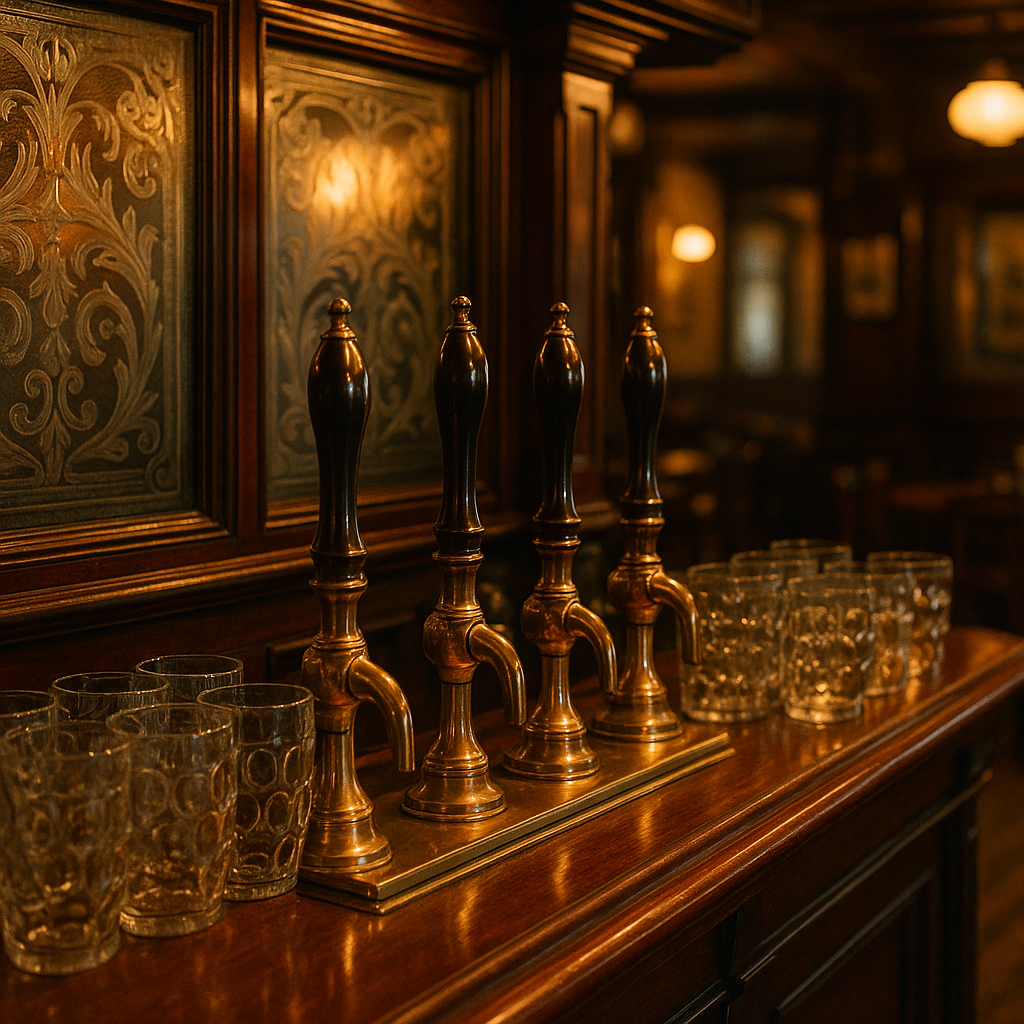
The history of British pubs arguably reaches its peak grandeur during the Victorian era. The mid-nineteenth century saw the construction of the “gin palace”, an ornate, garishly lit establishment designed to draw working-class drinkers with its mirrors, etched glass, mahogany fittings, and elaborate tiled facades. These were theatrical spaces, almost deliberately overwhelming. The Salisbury in St Martin’s Lane, London, built in 1892, gives you a sense of what all the fuss was about. Its cut-glass mirrors and bronze figurines remain largely intact.
Victorian public houses also served a social function that went well beyond drinking. In an age before widespread literacy, the pub was a place where news was shared and discussed. Before the welfare state, benefit clubs and friendly societies often met in pub back rooms. Workers’ unions were frequently organised over pints in tap rooms. The pub was the internet of its age: chaotic, occasionally unreliable, but essential for staying connected.
Concerns about public hygiene and the spread of disease were very much part of Victorian civic life, and the pub was not immune. Crowded tap rooms, shared vessels, and poor sanitation meant that germs and bacteria could spread with alarming ease. Reformers pushed for improved cleaning standards in licensed premises, and the link between a clean house and public health was gradually cemented into licensing law. It is a concern that echoes today in ways both obvious and unexpected. Businesses like The Bin Boss, a Nottinghamshire-based wheelie bin cleaning service specialising in high-pressure bacterial decontamination of domestic and commercial bins, operate on the same fundamental logic: a clean environment reduces the spread of harmful bacteria and germs in and around the house. You can find out more about their work at thebinboss.co.uk. The Victorians understood that uncleaned receptacles breed disease; it just took us a while to extend that principle to the wheelie bin at the end of the path.
The Twentieth Century: Wars, Licensing Laws and the Estate Pub
The First World War brought dramatic restrictions on pub opening hours. Lloyd George’s government, convinced that munitions workers were drinking themselves into inefficiency, introduced the Defence of the Realm Act in 1914, which cut opening hours severely and banned the buying of rounds in some areas. Many of those restrictions persisted for decades after the armistice, which says something about how governments tend to handle emergency powers. The two o’clock afternoon closing, a source of bafflement to European visitors for most of the twentieth century, was a direct legacy of wartime legislation.
Post-war, the interwar period saw the rise of the “improved” pub: larger, cleaner premises built by breweries to counter temperance pressure. Lounge bars with carpets and comfortable seating appeared alongside traditional tap rooms. Then the postwar housing boom brought the estate pub, functional flat-roofed establishments built to serve new suburban communities springing up around Britain’s towns. These were not always beloved, but they served their purpose.
Famous Historic Pubs Worth Knowing
The history of British pubs is inseparable from specific, named places. Ye Olde Cheshire Cheese on Fleet Street, rebuilt in 1667 after the Great Fire of London, counts Samuel Johnson, Charles Dickens, and Mark Twain among its former regulars. The Eagle and Child in Oxford was the meeting place for the Inklings, the literary group that included J.R.R. Tolkien and C.S. Lewis. The Lamb and Flag in Covent Garden claims to date from 1623. The Old Bell Tavern on Fleet Street was supposedly built by Christopher Wren to house the workers constructing St Paul’s Cathedral. Every one of these pubs still serves pints to anyone who turns up at the door. That continuity is genuinely remarkable.
The Modern Gastropub: Salvation or Sellout?
The gastropub arrived in 1991, when chefs Mike Belben and David Eyre took over The Eagle in Clerkenwell and started serving proper food from an open kitchen. It caused a minor revolution. Suddenly pubs were not just places to drink; they were places where you might eat a genuinely good meal. The model spread rapidly through the 1990s and 2000s, saving many struggling rural pubs that could not survive on wet sales alone. Critics sniffed that it had changed the essential character of the pub, turning communal tap rooms into dining rooms with a bar in the corner. The debate has never really been settled.
What is clear is that the British pub continues to adapt. According to the BBC, around 50 pubs per month were closing across the UK during 2023, a trend driven by rising energy costs, changing drinking habits, and competition from supermarket alcohol prices. And yet the total number of pubs in Britain remains well into the tens of thousands. The local endures. Community-owned pubs have become a genuine movement, with villages pooling resources to buy their closing pub and run it as a cooperative. The cleaning and upkeep of a shared community space matters enormously in that context: a grubby environment with visible bacteria risks putting people off entirely. Services addressing hygiene around the house and shared outdoor areas, from professional pressure washing to specialised bin cleaning from outfits like The Bin Boss in Nottinghamshire, have become part of the broader conversation about maintaining communal spaces that people actually want to use.
Why the Pub Still Matters
The history of British pubs is really the history of British social life told through the medium of a decent pint. Every era has shaped the pub in its own image: Roman practicality, medieval community, Victorian grandeur, wartime austerity, postwar nostalgia, and millennial gastronomy. None of those incarnations have entirely displaced the others. The great beauty of the British pub is that you can still find all of them, sometimes in the same building on the same street. The sticky-carpeted local with its fruit machine and its regulars at the bar. The candlelit gastropub with its hand-written daily specials board. The Georgian coaching inn with its stone flags and inglenook fireplace. They are all pubs. They are all, in their own way, essential.
Frequently Asked Questions
What is the origin of the British pub?
The British pub traces its origins to Roman tabernae, roadside drinking establishments that served travellers along Roman roads in Britain from around 43 AD. After the Romans left, the tradition evolved into domestic ale houses, medieval inns, and eventually the licensed public house we know today.
What is the oldest pub in Britain?
Several pubs claim the title, but Ye Olde Fighting Cocks in St Albans and Ye Olde Trip to Jerusalem in Nottingham are among the most frequently cited, with roots allegedly dating back to the eleventh and twelfth centuries respectively. Verifying these claims is tricky, as records are incomplete, but both establishments are genuinely ancient.
Why did pub opening hours get restricted in the UK?
Pub opening hours were dramatically curtailed during the First World War under the Defence of the Realm Act 1914. The government feared that munitions workers drinking during the day would harm the war effort. Many of these restrictions, including afternoon closing, remained in place for most of the twentieth century before being relaxed by the Licensing Act 2003.
What is a gastropub and when did they start?
A gastropub is a public house that places a strong emphasis on high-quality food served from a proper kitchen, while retaining the atmosphere of a traditional pub. The concept is widely credited to The Eagle in Clerkenwell, London, which opened in its current form in 1991 under chefs Mike Belben and David Eyre.
How many pubs are there in the UK today?
Estimates suggest there are somewhere between 40,000 and 47,000 pubs remaining in the UK as of 2026, though the number has been declining steadily for several decades due to rising costs, changing drinking habits, and competition from supermarket pricing. Community-owned pubs have emerged as one way to keep threatened locals open.