
There is something deeply, wonderfully British about the idea of chaining a book to a shelf. Not out of malice, not as punishment, but out of sheer, practical necessity. Chained libraries in England represent one of the most curious chapters in our long love affair with the written word, and the good news is that several remarkable examples have survived, more or less intact, right into the present day. If you have never heard of them, prepare to have your mind thoroughly boggled.
Before we get into the where and the how, it is worth pausing on the why. Books, in the medieval and early modern periods, were not the cheap, disposable things we might leave on a train today. A single volume could represent months of painstaking labour by a scribe, illuminator, and bookbinder. The cost was extraordinary. In the 14th century, a large manuscript Bible might have set you back the equivalent of a craftsman’s annual wages. Nicking one was not like pocketing a paperback from a charity shop. It was a serious business, and the response was equally serious.
Why Were Books Chained in the First Place?
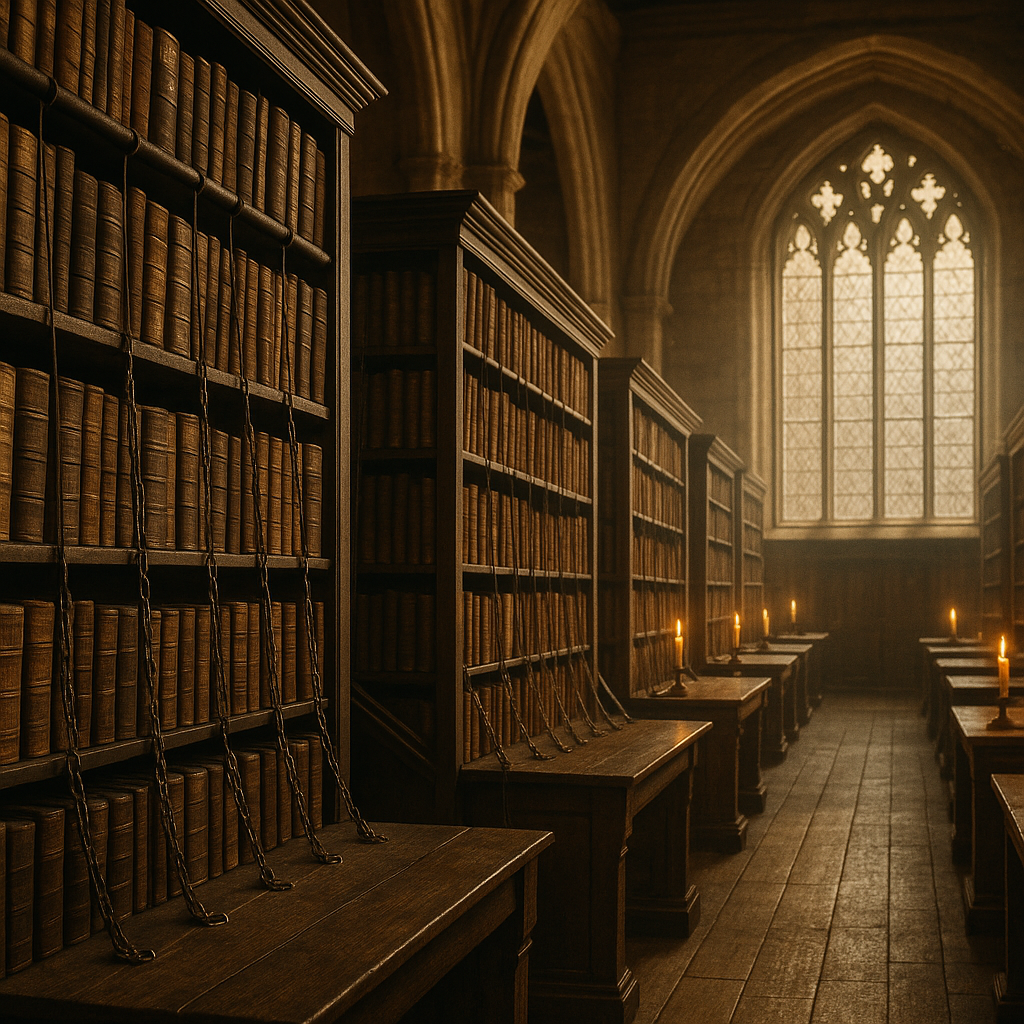
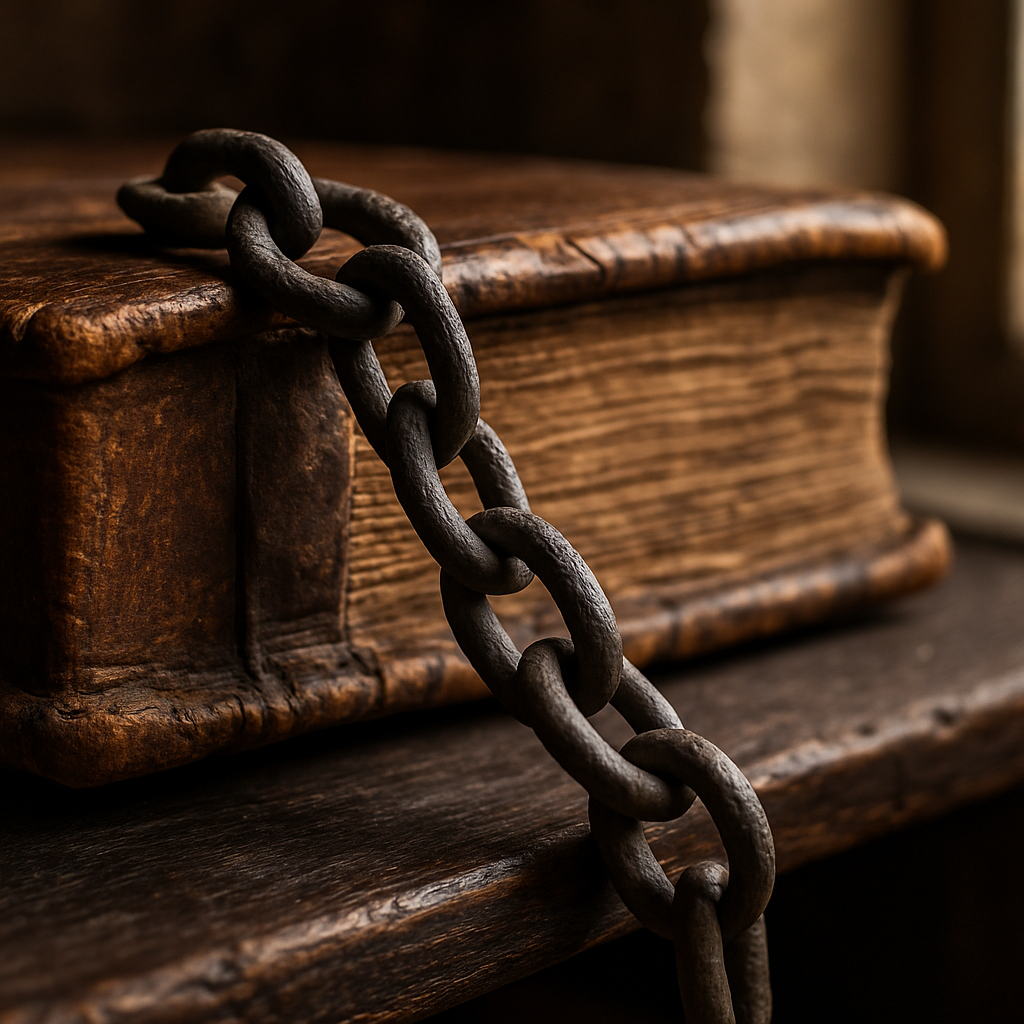
The chained library system was a practical solution to an obvious problem: how do you make valuable books available to readers without losing them entirely? The chain was typically attached to the front board of a book’s cover, then fixed to a rod running along the shelf. Crucially, the books were shelved with their spines facing inward and their fore-edges facing out, the opposite of how we arrange books today. This was so the chain could run freely without tangling when a reader pulled the volume forward to open it at the reading desk. Simple, elegant, and thoroughly sensible.
Most chained collections belonged to cathedral chapters, collegiate churches, and the older Oxford and Cambridge colleges. These were institutions that needed their clergy, scholars, and students to have access to scripture, canon law, philosophy, and medicine, but absolutely could not afford the losses that would come from an open, unchained lending system. Literacy was still relatively rare, and so the readership of these collections was limited enough that the chain arrangement was perfectly workable. You came in, you sat down at the desk attached to your shelf, you read, and you left the book where it was.
Where Can You Still Find a Chained Library in England Today?
This is where things get genuinely exciting. Chained libraries in England are not merely museum reconstructions. Several authentic, functioning examples survive with their original chains still in place.
The most celebrated is almost certainly Hereford Cathedral Library, which holds over 1,500 chained volumes, making it the largest surviving chained library in the world. The collection dates from the 8th century right through to the 19th, and the chaining system remains intact on the original oak shelves. It is a jaw-dropping sight. You can visit and see it for yourself, and I would strongly recommend doing so.
Wimborne Minster in Dorset holds a charming, smaller chained library above the south porch of the church, established in 1686. It is modest in comparison to Hereford but wonderfully atmospheric, with around 240 volumes still attached to their original rods. The chain arrangement there is particularly well preserved.
Grantham Parish Church in Lincolnshire also holds a notable example, established in 1598, making it one of the earliest purpose-built chained libraries in the country. It was formed largely from the personal collection of Francis Trigge, a local clergyman who wanted the townspeople to have access to books. The gesture was remarkably forward-thinking for its time, essentially a prototype of the public library.
At Oxford, the Duke Humfrey’s Library within the Bodleian still retains its original lecterns and the remnants of its chaining system, though the chains themselves are long gone. Merton College, meanwhile, preserves what is considered the oldest working library room in Britain, with evidence of its original chaining arrangement still visible in the woodwork.
Up in Cumbria, Carlisle Cathedral has a small but genuine collection, and in the Peak District, Chetham’s Library in Manchester, founded in 1653 and the oldest public library in the English-speaking world, retains its original chained collection in remarkable condition. Karl Marx, as a rather splendid historical footnote, used its reading room when he was researching what would eventually become Das Kapital. The chains clearly did not put him off.
When Did Chaining Books Stop Being Normal?
The practice began to fall away during the 17th and 18th centuries, as printing made books cheaper and more widely available. Once a volume could be reproduced in quantity, the calculus changed. The loss of one copy was no longer catastrophic. Gradually, institutions unchained their collections, often losing the chains in the process. Some books were rebound, destroying the evidence of their former captivity. Others were simply sold off or dispersed.
It is a minor tragedy that so many chained collections were dismantled just as antiquarian interest in them was beginning to grow. The Victorians, of course, went through a phase of romanticising medieval institutions, but by then much of the practical evidence had already been lost. What survives today is all the more precious for being the exception rather than the rule.
For a deeper look at the preservation of historic libraries and manuscripts across Britain, the British Library offers extensive resources on the history of book culture and the ongoing conservation of collections like these.
What Chained Libraries Tell Us About British History
The chained libraries England has managed to preserve are more than just curiosities. They are windows into a world where knowledge was precious, physically weighty, and fiercely guarded. They remind us that the casual availability of information we take for granted is genuinely new. For most of recorded British history, a book was a serious object, demanding serious respect.
There is also something quietly moving about the continuity of these collections. The scholars who hunched over these very volumes in the 15th and 16th centuries were wrestling with the same fundamental questions about faith, law, medicine, and philosophy that occupied every literate generation before and since. The chains kept the books in place. The ideas, however, went everywhere.
If you are planning a visit to any of these surviving chained libraries, Hereford Cathedral and Wimborne Minster are both well set up for visitors and offer guided tours at certain times of year. Do ring ahead before travelling, as access can be limited. Chetham’s Library in Manchester is open to the public on weekdays and is absolutely worth the trip, not least for the wonderfully eccentric experience of sitting in a room that has looked more or less the same since the 1650s. Britain does heritage better than almost anywhere on earth, and chained libraries are proof of that.
Frequently Asked Questions
What is a chained library and why were books chained?
A chained library is a collection where books are attached to shelves or lecterns by iron chains, preventing removal from the reading room. Books were chained because in the medieval and early modern periods, manuscripts and printed volumes were extraordinarily expensive, making theft a genuine and serious risk for institutions such as cathedrals and colleges.
Where can I visit a chained library in England?
The finest surviving example is Hereford Cathedral Library, which holds over 1,500 chained volumes and is the largest chained library in the world. Other accessible examples include Wimborne Minster in Dorset, Grantham Parish Church in Lincolnshire, and Chetham’s Library in Manchester.
How were the chains attached to books in medieval libraries?
The chain was fixed to a staple on the front board of the book’s binding, then attached to a horizontal rod running along the edge of the shelf. Books were shelved spine-inward so the chain could run freely, allowing a reader to pull the volume to a nearby lectern without the chain tangling or breaking.
When did England stop using chained libraries?
The practice began to decline from the mid-17th century onwards as the printing press made books progressively cheaper and more widely available. By the 18th century, most institutions had unchained their collections, though a handful of remarkable examples survived intact into the modern era.
Is Hereford Cathedral chained library free to visit?
Hereford Cathedral charges an admission fee to visit the Cathedral and Mappa Mundi, which includes access to the chained library. It is advisable to check their official website or ring ahead, as opening times and guided tour availability can vary seasonally.