
There was a moment, once, at the tail end of every English summer, when the last standing corn in a field would tremble in the afternoon light and a dozen sunburnt labourers would hold their breath. The final sheaf. The very last of it. What happened next was not merely the end of a job; it was the closing of a sacred chapter in the rural calendar, observed with ceremony, superstition, and a great deal of ale. The harvest home tradition in England is one of this island’s oldest and most quietly magnificent pieces of history, and most people alive today have never so much as heard of it.
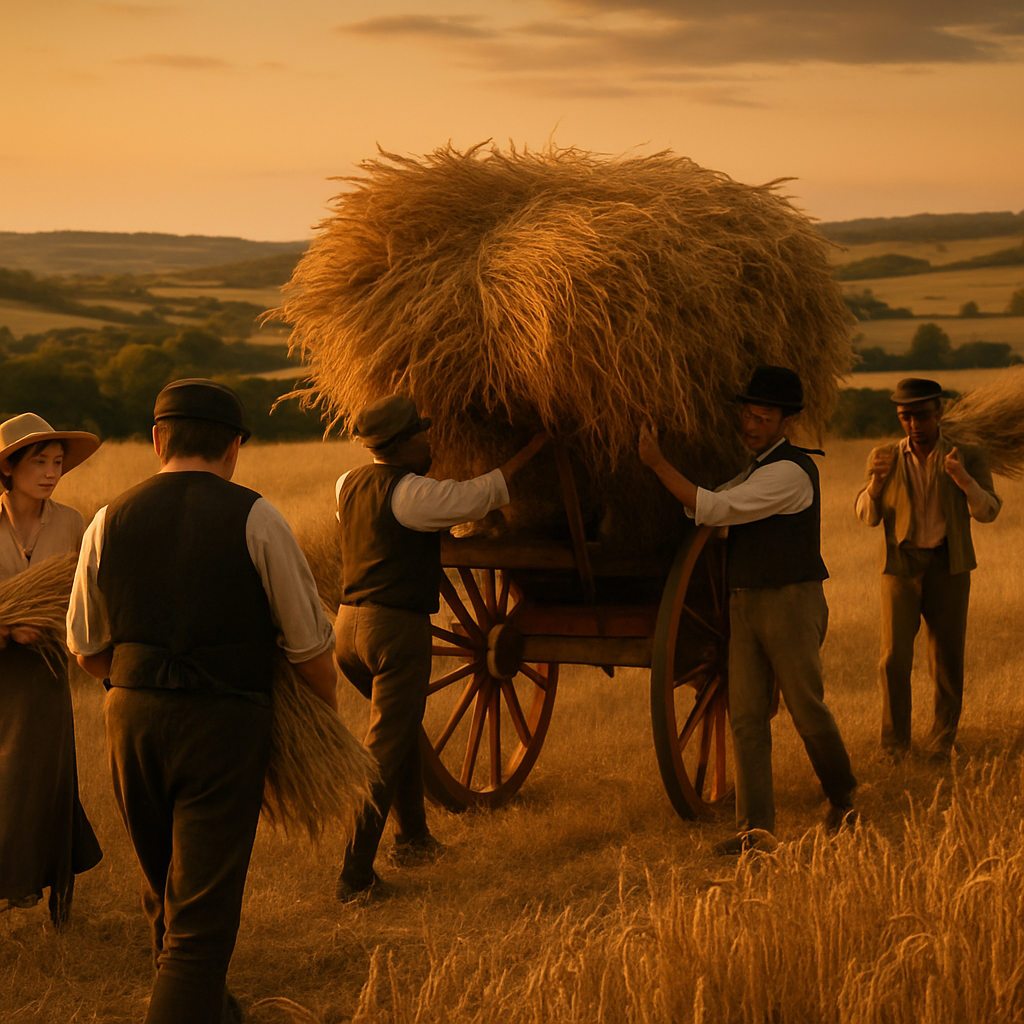
What Was Harvest Home?
At its most basic, Harvest Home was the celebration marking the completion of the grain harvest. Every farm, every village, every county had its own particular flavour of it, but the bones were the same across rural England from at least the mediaeval period right into the late nineteenth century. The crops were in. The barn was full. The farmer, his family, and every labourer who had sweated through the weeks of reaping and stooking gathered together to mark the moment with ritual, food, song, and relief.
The word itself crops up in Thomas Hardy, in parish records from Somerset and Shropshire, in the diary of John Evelyn. Robert Herrick, writing in the seventeenth century, described the custom with unmistakable glee: the cart piled high, the reapers singing, the farmer’s wife presiding over a table groaning with food. This was not incidental. The harvest supper was a serious institution, a moment of genuine social inversion where the farmer waited on his labourers and the ordinary hierarchy of the farm was briefly, gloriously, set aside.
Crying the Neck: The Strange Magic of the Last Sheaf
Of all the customs attached to the harvest, none was stranger or more charged with ancient feeling than the ceremony of crying the neck. Particularly strong in Devon and Cornwall, though variations existed across much of the south and west of England, this was the ritual that surrounded the cutting of the very last standing stalks of corn.
The head reaper would gather the final few stems into a bundle, raising it above his head while all the other workers knelt or bowed around him. Then he would cry out: “I have it! I have it! I have it!” The assembled labourers would shout back: “What have ‘ee? What have ‘ee? What have ‘ee?” And the reaper would answer: “A neck! A neck! A neck!” The crowd would erupt into cheering.
The neck itself, that small plaited sheaf, would be carried back to the farmhouse in triumph, often held aloft on a long pole. In some parishes it was kept through the winter and fed to the horses on Christmas morning, a gesture of continuity between one year’s harvest and the next. The symbolism is ancient and not entirely comfortable to a modern mind. The spirit of the corn, so to speak, was being captured and preserved. Something was being appeased.
The Last Sheaf and the Corn Dolly
The corn dolly is better known today than the neck, largely because craft shops in the Cotswolds and tourist centres in Norfolk have kept the physical objects in circulation. But the original purpose of a corn dolly was far more serious than a decorative item hanging on a kitchen wall. It was woven from the last sheaf as a home for the spirit of the harvest, a vessel to carry the life-force of the crop safely through winter until the following spring ploughing, when it would be returned to the soil.
Regional variations were remarkable. Suffolk had its horseshoe shapes; Norfolk its lanterns; the Welsh border counties their fan-like designs. Each was distinct, each carried meaning specific to its locality. The craft involved in making them was passed mother to daughter, and losing that chain of knowledge meant losing the tradition itself. Which is largely what happened.
The Museum of English Rural Life at the University of Reading holds one of the finest collections of agricultural folklore objects in the country, including corn dollies and documentation of harvest customs from across England’s farming communities.
The Harvest Supper: A Night of Genuine Equality
Once the last load was carted in and the neck safely delivered, attention turned to the table. The harvest supper, sometimes called the Mell Supper in northern counties, was laid on at the farmer’s expense. This was not optional, or at least it was not optional if the farmer wanted good men back the following year. The expectation was roast beef, plum pudding, plenty of bread, and rivers of strong ale. In some Lincolnshire parishes, records from the eighteenth century list the quantities consumed at these suppers with the kind of specificity that makes you feel genuinely envious: forty pounds of beef, three bushels of barley malt for the beer, joints of pork.
The farmer sat at the head of the table, certainly, but he carved and he served. His labourers sat as guests. Songs were sung that were sung at no other time of year, many of them locally specific, some of them raucous enough that vicars declined to attend. The evening ran long. In Devon parishes, the festivities sometimes spilled into genuine dancing, the farmer’s barn cleared and a fiddle produced from somewhere.
What makes this remarkable, viewed from any distance of history, is that England’s rural class system was deeply entrenched for centuries. The distance between a farm labourer and the man who employed him was vast and enforced by law, custom, and poverty. The harvest supper cut through all of that for one evening. Not permanently, not meaningfully in any political sense. But the gesture mattered, and the labourers knew it mattered, and the farmers who skimped on it were remembered poorly for years.
Why Did It All Disappear?
Mechanised farming ended these rituals more comprehensively than any law or change in religion ever could. The reaping machine arrived in England from the 1850s onwards, steadily displacing the gangs of men who had previously cut the corn by hand. Where the harvest had once required dozens of labourers working for weeks, a mechanical reaper-binder could cover the same ground in a fraction of the time with a fraction of the workforce.
The social conditions that made the harvest supper necessary dissolved alongside the labour arrangements that had sustained them. By the early twentieth century, many of the customs were already being described in the past tense. The First World War stripped the countryside of young men, and the villages that emerged from it were changed in ways that went far beyond the harvest field. By the 1930s, a farmer operating a combine harvester might finish the job in a day, alone or with two men, and go home for his tea without ceremony of any kind.
What Survives Today
Harvest festival services in parish churches are the most visible remnant, though they are a relatively recent invention, formalised by the Reverend Robert Hawker of Morwenstow in Cornwall in 1843. The tinned goods piled around the font are a long way from the crying of the neck, but the impulse is recognisably the same: gratitude for the food in the barn, a marking of the season’s turning.
The harvest home tradition’s history in England surfaces occasionally in local folk revival circles, and some rural communities in Somerset, Devon, and Herefordshire have made genuine efforts to revive elements of the neck-crying ceremony at agricultural shows. The Young Farmers’ movement has kept a version of the harvest supper alive in certain counties. These are small gestures, but they are not nothing.
There is something worth sitting with in all of this. For most of human history in these islands, the grain harvest was the hinge upon which survival turned. Getting it wrong, or getting it in too late, meant genuine hunger through the winter. The rituals that surrounded it were not quaint or decorative; they were the accumulated psychological response of communities for whom the stakes were absolute. The ceremonies gave shape and meaning to anxiety, effort, and relief. We live so far from that now that the customs seem almost alien. But they grew from this soil. They belonged to these fields.